
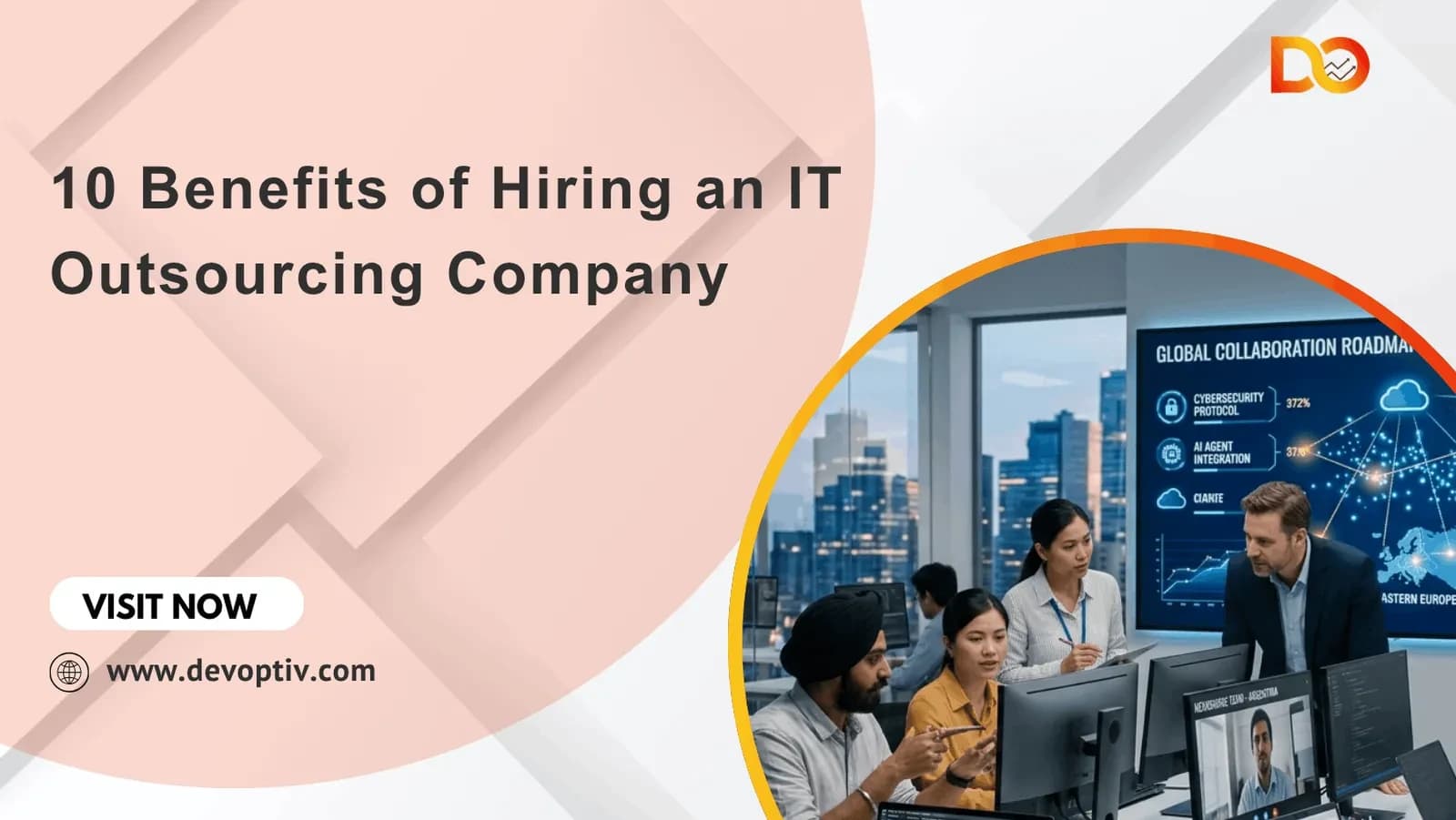
If you think an IT outsourcing company is just a way to cut costs, you are missing its biggest advantage: growth acceleration.
Most CTOs and founders who come to us have already run the numbers on hiring. They know that recruiting a senior developer in the US or UK takes 3–4 months and costs $120,000+ per year before benefits. What they have not fully calculated is the opportunity cost of moving slowly delayed product launches, engineering bottlenecks, and competitors shipping while they are still interviewing.
This guide breaks down all 10 benefits of working with an IT outsourcing company with specifics, not generalities so you can make a fully informed decision. Devoptiv has delivered outsourced engineering and custom software development across fintech, SaaS, and enterprise sectors, and this guide reflects what actually moves the needle for our clients.
What is an IT outsourcing company? An IT outsourcing company is a third-party partner that manages software development, infrastructure, or technical operations helping businesses scale faster, access global talent, and reduce operational complexity without the overhead of full-time hiring.
Why Businesses Are Moving to IT Outsourcing
The numbers tell a clear story. According to Statista, the global IT outsourcing market is projected to surpass $591 billion by 2026, driven by accelerating demand from companies that cannot keep pace with technology complexity through in-house teams alone.
Companies that outsource IT development report 30–50% reductions in time-to-market for new products. The driver is not cheaper labour, it is access to assembled, experienced teams that are ready to build on day one, with no ramp-up period, no onboarding delay, and no learning curve on your dime.
The talent shortage compounds the urgency. There are currently over 4 million unfilled tech jobs globally. An IT outsourcing company solves this problem by giving you access to a pre-vetted, continuously active talent network without the 90-day hiring cycle.
Benefit 1: Access to a Global Talent Pool
The problem: Finding AI engineers, DevOps specialists, or cybersecurity architects in your local market is slow, expensive, and increasingly competitive.
The solution: An IT outsourcing company maintains active relationships with specialists across disciplines from React developers to machine learning engineers across multiple geographies.
The outcome: You get the right skill set matched to your project within days, not months. For a fintech startup that needed a HIPAA-compliant backend developer, the alternative was a 3-month search. Through outsourcing, that gap was filled in under two weeks.
Pro Tip: When evaluating an IT outsourcing partner, ask specifically about their talent bench depth in your stack, not just their headline capabilities. A partner who can place five React developers today is worth more than one who promises to hire them for you.
Benefit 2: Faster Time-to-Market
The problem: Engineering bottlenecks are the number-one reason product launches slip. Internal teams are context-switching between maintenance and new builds simultaneously.
The solution: An outsourced IT team operates in parallel with your existing team handling new feature development, legacy modernisation, or infrastructure work while your core team stays focused.
The outcome: Companies that use dedicated outsourced teams consistently report 2–3x faster delivery on greenfield projects. One e-commerce platform we worked with launched their mobile checkout in 6 weeks down from an internal estimate of 5 months.
Benefit 3: Scalability on Demand
The problem: Business demand is not linear. You need 8 developers for a product sprint and 2 for maintenance. Hiring full-time for a sprint is not economically rational.
The solution: Outsourced teams scale up and down with your workload, with no redundancy costs, no severance, and no HR overhead.
The outcome: Cost-efficient growth. You pay for output, not for headcount. This is the operational model that allows startups to compete with enterprises and enterprises to move at startup speed.
Devoptiv Insight: The most common mistake companies make is treating outsourcing as a binary choice full outsourcing or full in-house. The highest-performing model is a hybrid: a small internal core team sets direction, and an outsourced delivery team executes at scale.
Benefit 4: Driving Growth by Focusing on Core Activities
The problem: When your internal team is managing servers, debugging infrastructure, or maintaining legacy code, they are not building the product that generates revenue.
The solution: Hand infrastructure management, QA, and non-core development to an IT outsourcing company. Your internal engineers focus exclusively on product innovation and competitive differentiation.
The outcome: Higher business growth velocity. Every hour your A-team spends on commoditised technical work is an hour not spent on the work only they can do.
Benefit 5: Staying Ahead with the Latest Tech Innovations
The problem: Staying current with AI tooling, cloud-native architecture, and modern DevOps practices requires continuous investment in training which most companies cannot sustain across a full internal team.
The solution: A mature IT outsourcing partner is already working with these technologies across multiple client projects. They bring capability that is already proven, not theoretical.
The outcome: Innovation without overhead. You get production-grade AI integration, Kubernetes orchestration, or event-driven architecture without hiring a specialist or running a 6-month training programme.
[CTA 2 Mid-body, post Benefit 5]: Ready to bring modern technology capabilities into your product without a full hiring cycle? Explore our software development services and see what your team could build next.
Benefit 6: Reduced Operational Risk
The problem: Internal teams regardless of talent carry key-person risk. When one engineer holds critical system knowledge and leaves, the exposure is significant.
The solution: An IT outsourcing company operates with documented processes, redundant team structures, and knowledge management built into their delivery model. No single departure disrupts the project.
The outcome: Stable, secure operations. Experienced outsourced teams also bring compliance awareness SOC 2, ISO 27001, GDPR as a standard part of their delivery practice, not an afterthought. You can also pair this with dedicated cloud security services to build a fully resilient technical foundation.
Benefit 7: Improved Productivity and Efficiency
The problem: In-house teams often carry technical debt that slows every new delivery. Process inefficiencies compound quietly until releases take weeks instead of days.
The solution: Outsourced teams bring proven delivery workflows, agile sprint structures, CI/CD pipelines, automated testing that reduce cycle times immediately.
The outcome: More output in less time. Teams experienced in DevOps automation consistently reduce release cycle times by 40–60% within the first quarter of engagement.
From the Field: One SaaS client came to us with a 3-week release cycle. After implementing their outsourced team's CI/CD pipeline and automated testing framework, they shipped weekly within 60 days without adding a single internal hire.
Benefit 8: Business Continuity and Reliability
The problem: Single-vendor or single-team dependency creates fragile operations. One resignation, one illness, one team conflict and delivery stalls.
The solution: IT outsourcing companies operate with backup coverage, documented systems, and team redundancy as structural features not optional add-ons.
The outcome: Zero-disruption delivery. Your roadmap moves forward regardless of what happens on any given day. This is particularly critical for companies operating across time zones or with 24/7 uptime requirements.
Benefit 9: Strategic Partnership, Not Just Execution
This is the benefit most outsourcing guides get wrong. They treat IT outsourcing as a purely transactional relationship you give scope, they deliver code.
The best IT outsourcing companies operate as strategic growth partners. They flag architectural decisions that will create technical debt. They challenge requirements that will slow you down. They bring market intelligence from working across industries that your internal team simply does not have visibility into.
At Devoptiv, we do not just deliver code, we work with your leadership team to ensure every technical decision is aligned with your business model and growth stage. See the work we have delivered for companies that started with a single project and grew into long-term partnerships.
Benefit 10: Sustained Competitive Advantage
The cumulative effect of faster delivery, better technology, lower risk, and strategic guidance is a compounding competitive advantage. Companies that outsource intelligently ship more, maintain cleaner codebases, and iterate on customer feedback faster than those constrained by internal hiring cycles.
The question is not whether outsourcing saves money. The question is whether your competitors are moving faster than you and whether your current resourcing model lets you keep up.
IT Outsourcing vs In-House: Side-by-Side Comparison
Factor | In-House Team | IT Outsourcing Company |
|---|---|---|
Time to hire | 60–120 days | 5–14 days |
Cost flexibility | Fixed (salary + benefits) | Variable (scale up/down) |
Skill coverage | Limited to who you can hire locally | Global specialist access |
Scalability | Slow, high-friction | On-demand |
Technology currency | Requires ongoing training investment | Built-in across active client base |
Key-person risk | High | Low (team-based delivery) |
Compliance/security | Requires dedicated resourcing | Standard in delivery model |
Innovation velocity | Moderate | High |
Who Should Hire an IT Outsourcing Company?
Startups that need to move fast without the overhead of building an internal engineering function from scratch. Speed and capital efficiency are the primary drivers.
Growing SMEs that have a strong product direction but lack the in-house depth to execute across multiple technology disciplines simultaneously.
Enterprises that need to scale specific technical workstreams: a product modernisation, a cloud migration, a new mobile application without diverting internal teams from core operations.
If your company is in any of these categories and is currently constrained by hiring timelines, technical skill gaps, or engineering bandwidth, an IT outsourcing company is not a cost-cutting measure. It is a growth infrastructure decision. If your situation matches any of the above, a 30-minute call with our team will give you a clear picture of what outsourcing looks like for your specific stage. Get in touch, no sales pitch, just a direct conversation.
Conclusion
An IT outsourcing company is not a cost-cutting tool. It is a growth infrastructure decision that gives you access to global talent, faster delivery, proven technology, and strategic guidance without the overhead, risk, and time investment of building everything in-house.
The right IT outsourcing company does not reduce your costs. It multiplies your capabilities.
Ready to See What Your Team Could Build?
If you are evaluating IT outsourcing for the first time or looking to upgrade a current partnership, Devoptiv delivers dedicated engineering teams for software development, cloud, DevOps, and digital products.
We have delivered for 40+ companies across fintech, SaaS, and enterprise and we can show you exactly how we would approach your project. Book My Free Discovery Call
FAQs About IT Outsourcing
What does an IT outsourcing company actually do?
An IT outsourcing company manages software development, technical infrastructure, QA, DevOps, or end-to-end product engineering on behalf of its clients. The engagement model varies from dedicated development teams to project-based delivery but the core value is the same: you get experienced technical execution without the cost and complexity of building that capability internally.
Is IT outsourcing only cost-effective for large enterprises?
No. The cost-efficiency of outsourcing scales with company size in different ways. For startups, the primary benefit is access to senior expertise without a full-time salary commitment. For SMEs, it is skill coverage across multiple disciplines. For enterprises, it is scalability and speed. The model works across stages because the underlying economics paying for output rather than overhead apply universally.
What are the real risks of IT outsourcing, and how do you mitigate them?
The three most cited risks are communication gaps, quality inconsistency, and security exposure. All three are mitigated through partner selection: look for partners with documented delivery processes, dedicated project management, clear SLAs, and compliance certifications (SOC 2, ISO 27001). A partner who cannot articulate their quality and security model clearly is not a partner worth the risk.
How do I choose the right IT outsourcing company?
Evaluate five things: technical depth in your specific stack, client references in your industry, delivery methodology (agile sprint structure, code review process, documentation standards), communication model (dedicated PM, async vs. real-time), and security/compliance posture. Do not make the decision on day rate alone; the cheapest option is rarely the most cost-effective over the life of a project.
How long does it take to get started with an outsourced IT team?
With a partner that has an active talent bench, onboarding a dedicated team takes 5–14 days from signed agreement to first sprint. This includes discovery, team matching, environment setup, and kickoff. Compare this to 60–120 days for an equivalent in-house hire.
Can outsourced teams work alongside our existing internal developers?
Yes and this is the most common engagement model. Outsourced teams integrate into your existing sprint structure, use your project management tools, attend your standups, and operate as an extension of your internal team rather than a separate external vendor. The hybrid model consistently delivers better results than full outsourcing or full in-house resourcing.