
Devoptiv
April 6, 2026
|14 min to read
|
Attorney SEO services are specialized search engine optimization strategies designed specifically for law firms and legal practices. Unlike generic SEO, attorney SEO accounts for YMYL (Your Money or Your Life) content standards, bar association advertising rules, local jurisdiction targeting, and the trust signals Google applies to sites where users make high-stakes decisions.
Attorney SEO services improve a law firm's search engine rankings through targeted keyword research, on-page optimization, local SEO, authority-building content, and technical site performance all calibrated to the specific compliance and trust requirements of the legal industry. The goal is to place your firm in front of potential clients at the exact moment they search for legal help.
SEO for attorneys covers six interconnected disciplines: keyword strategy, on-page optimization, content marketing, link building, local SEO, and technical performance. Removing any one element weakens the entire structure.
Why SEO for Attorneys Delivers Results Other Channels Cannot
Paid advertising stops the moment you stop paying. Referrals are unpredictable. Attorney SEO compounds over time rankings built in month three continue paying dividends in month eighteen.
Three advantages stand out:
Traffic quality: Searchers using terms like "DUI attorney Chicago" or "wrongful termination lawyer" are not browsing passively. They have a specific, urgent legal need. This intent drives conversion rates that paid social cannot match.
Credibility transfer: According to Moz's research on search behavior, users consistently perceive top-ranked results as more trustworthy a critical factor when someone is choosing who will represent them in a lawsuit, a divorce, or a criminal matter.
Long-term cost efficiency: Unlike Google Ads where cost-per-click for legal keywords can exceed $50–$200 organic rankings do not carry a per-click cost. The investment is in building the asset, not renting visibility.
If you want to see what results look like in practice, our client portfolio includes examples across competitive service verticals.
The Six Core Components of Law Firm SEO in 2026
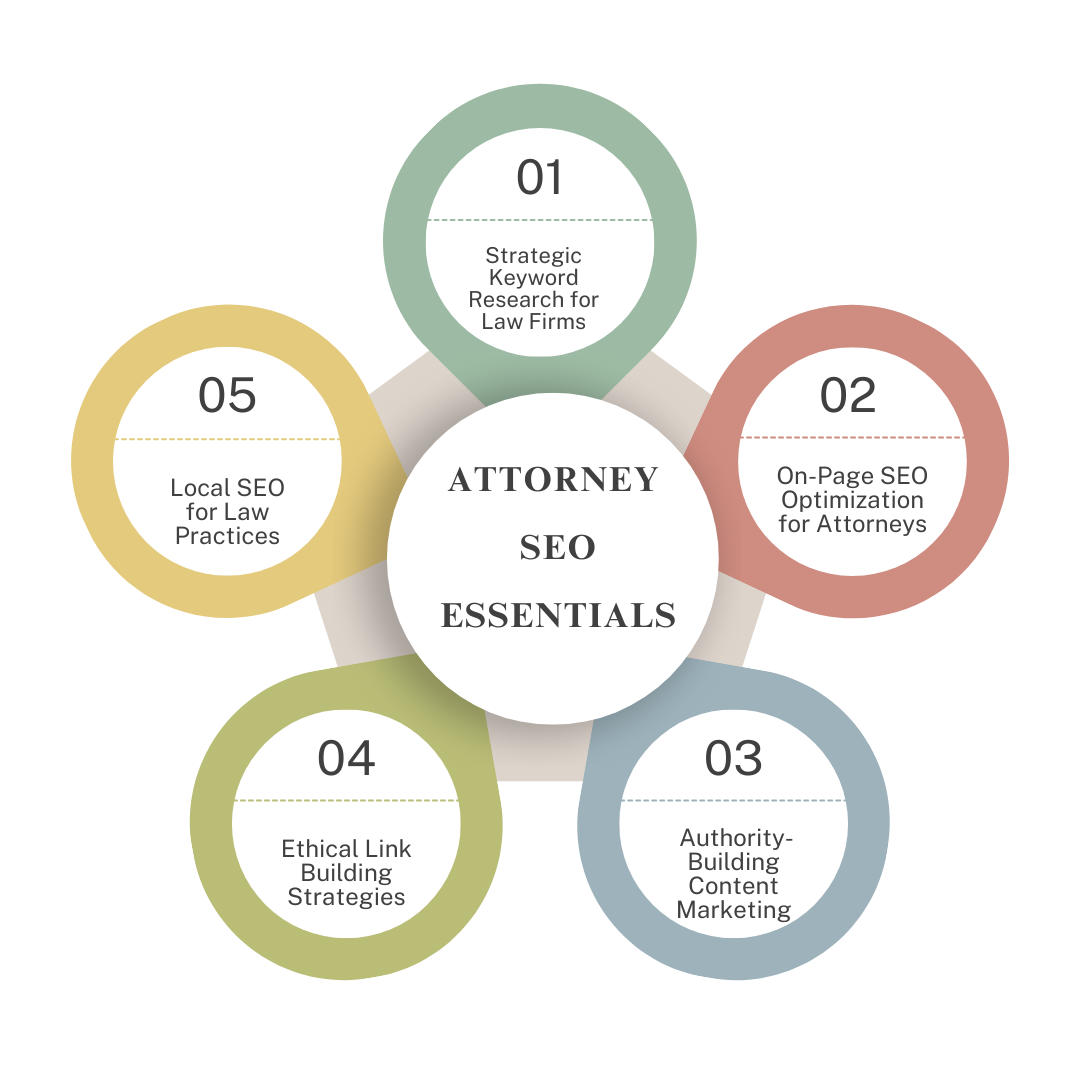
1. Strategic Keyword Research for Law Firms
Keyword research for attorneys is not about finding the highest-volume terms. It is about finding the terms your ideal clients actually use, in the markets you serve, at the moment they are ready to hire.
Three tactics that work in 2026:
Question-based queries: Target "how," "what," and "can I" phrases (e.g., "How do I choose a divorce attorney?" or "Can I sue my employer for wrongful termination?"). These map directly to featured snippet opportunities.
Local intent keywords: "DUI lawyer Miami" converts at a fundamentally different rate than "DUI attorney." Always pair the practice area with geography.
Long-tail variations: Phrases with four or more words carry lower competition and higher purchase intent. A term like "affordable estate planning attorney in Austin" has far less competition than "estate planning attorney" while attracting a more qualified visitor.
Pro Tip: Most clients searching for legal help include a location qualifier in their query. If your keyword list lacks geo-modified terms, you are optimizing for searchers who will never call you.
2. On-Page SEO Optimization for Attorneys
On-page SEO aligns your website's content and structure with what search algorithms and real users need to see.
Critical elements for law firm pages:
Title tags: Front-load the primary keyword. "Car Accident Attorney | [Firm Name]" outperforms "Welcome to [Firm Name] Personal Injury Law."
Header hierarchy: Use H2s for each practice area, H3s for subtopics within that area (e.g., "Types of Compensation Available in a Car Accident Claim").
Keyword density: 1–2% for the primary term, naturally integrated. Overuse triggers penalties; underuse signals weak relevance.
E-E-A-T signals: Google evaluates Experience, Expertise, Authoritativeness, and Trustworthiness for all YMYL pages. Named attorneys with credentials, verifiable case results, and bar admission details directly improve these signals.
3. Authority-Building Content Marketing
Content is the mechanism through which attorney SEO compounds. Firms that publish once per month and stop rarely see meaningful organic growth. Those that build structured content programs around their practice areas rank for dozens of related queries simultaneously.
Three formats that produce results:
Pillar pages: Comprehensive 3,000–5,000-word guides covering broad practice areas (e.g., "The Complete Guide to Workers' Compensation Claims in Texas"). These rank for high-volume head terms and internally link to supporting posts.
FAQ hubs: Dedicated pages answering the 20–30 most common questions in a practice area, structured with schema markup for rich snippet eligibility.
Video content: Short (90–120 second) explainer videos embedded in blog posts reduce bounce rates and increase dwell time both positive ranking signals. A video explaining "The 5 Steps of a Personal Injury Claim" works harder than a wall of text covering the same ground.
Devoptiv Insight: Google's Helpful Content updates since 2023 have aggressively demoted generic, surface-level legal content. Articles that cite specific statutes, name jurisdictions, and reference actual procedural steps significantly outperform generic "what is personal injury law" posts. Depth and specificity are the differentiators now.
Our digital marketing services include structured content programs built around exactly this kind of topical authority development.
4. Ethical Link-Building for Law Firms
Backlinks from authoritative, relevant sources remain one of Google's strongest ranking signals. For law firms, link building must also comply with bar association advertising rules which prohibit some forms of testimonials, guarantees, and comparative claims that are standard practice in other industries.
Approved methods that work:
State bar association blogs: Guest articles on bar association publications earn high-authority links without compliance risk.
Legal resource links: Court websites, legal aid organizations, and government resources that reference your guides as helpful reading carry strong trust signals.
Local business citations: Chambers of commerce, local business directories, and community organization mentions build local authority that feeds directly into map pack rankings.
Tactics to avoid: buying links, participating in link schemes, or publishing "sponsored" articles on low-quality legal directories. Google's Penguin algorithm has become increasingly accurate at detecting and penalizing these patterns.
5. Local SEO for Law Practices
For most law firms, the majority of revenue comes from clients within a defined geographic radius. Local SEO determines whether your firm appears when someone searches for "attorney near me" or "[practice area] lawyer [city]."
Three actions that produce measurable results within 90 days:
Google Business Profile optimization: Complete every field practice areas, licensed states, office hours, Q&A, and a consistent stream of client reviews. Profiles with 10+ reviews and complete information appear in the map pack at a significantly higher rate.
NAP consistency: Your Name, Address, and Phone number must match exactly across every directory listing Google, Yelp, Avvo, Justia, and 50+ others. Inconsistencies confuse Google's location signals and suppress local rankings.
Geographic service pages: Build individual pages for each city or county you serve (e.g., "/personal-injury/naperville" or "/dui-attorney/schaumburg"). Each page should include locally relevant content, not just a find-and-replace of the city name.
Pro Tip: According to Google Search Central's local search documentation, proximity, relevance, and prominence are the three factors that determine local pack rankings. Prominence is the one most improved by consistent review acquisition and building a systematic process for requesting reviews post-case-resolution.
6. Technical SEO Essentials
Technical SEO removes the barriers that prevent search engines from crawling, indexing, and ranking your pages regardless of how good the content is.
2026 priorities for law firm websites:
Core Web Vitals: Achieve load times under 2 seconds. Image compression, browser caching, and a content delivery network (CDN) are the fastest wins. Google's Page Experience signals now directly influence rankings.
Mobile optimization: 35% of legal searches now originate from mobile devices. Test specifically on mobile and tablet, not just desktop.
Security and compliance: HTTPS is table stakes. For law firms handling client intake forms, GDPR and CCPA compliance in your tracking setup is both a legal requirement and a trust signal.
Schema markup: Implement LegalService schema on service pages and FAQPage schema on your FAQ sections. Schema increases eligibility for rich results, which increase CTR without requiring ranking improvements.
2026 Attorney SEO Trends You Cannot Ignore
AI-Powered Search Is Reshaping Legal Queries
Google's AI Overviews (formerly SGE) now appear for a significant portion of legal queries, presenting synthesized answers before the organic results. Firms that structure content to answer complex questions concisely within 50–80 words are being sourced by AI Overviews as citation references, generating visibility even in zero-click search environments.
To compete here: write direct, factual answers at the top of every major section. Structure beats creativity in AI-summarized results.
Voice Search Optimization for Legal Services
A growing percentage of users initiate legal searches via voice assistant queries phrased as "Find a car accident lawyer near me" or "What should I do after a workplace injury?" Voice queries are conversational, question-based, and almost always local. Optimizing for these means writing FAQ content in natural spoken language and ensuring your Google Business Profile is fully populated with service area data.
Hyper-Local and Map Pack Dominance
Google's local algorithm has increased the weight given to real-time engagement signals: recent reviews, Q&A responses, post updates, and photo freshness. Firms that treat their Google Business Profile as a static listing are losing map pack positions to competitors who treat it as an active channel. Firms not appearing in the three-pack miss approximately 90% of local search clicks.
AI-Enhanced Content Personalization
Machine learning now enables delivery of different content experiences based on inferred user intent. A first-time DUI offender researching their options needs different content than a business owner facing an employment lawsuit. Law firms working with experienced digital marketing partners can implement content paths that serve different segments improving engagement, reducing bounce, and increasing the probability of a contact form submission.
How to Choose the Right SEO Company for Attorneys
The legal SEO market includes dozens of agencies claiming specialization. Most are generalists who adapted their pitch. Here is how to distinguish the legitimate ones.
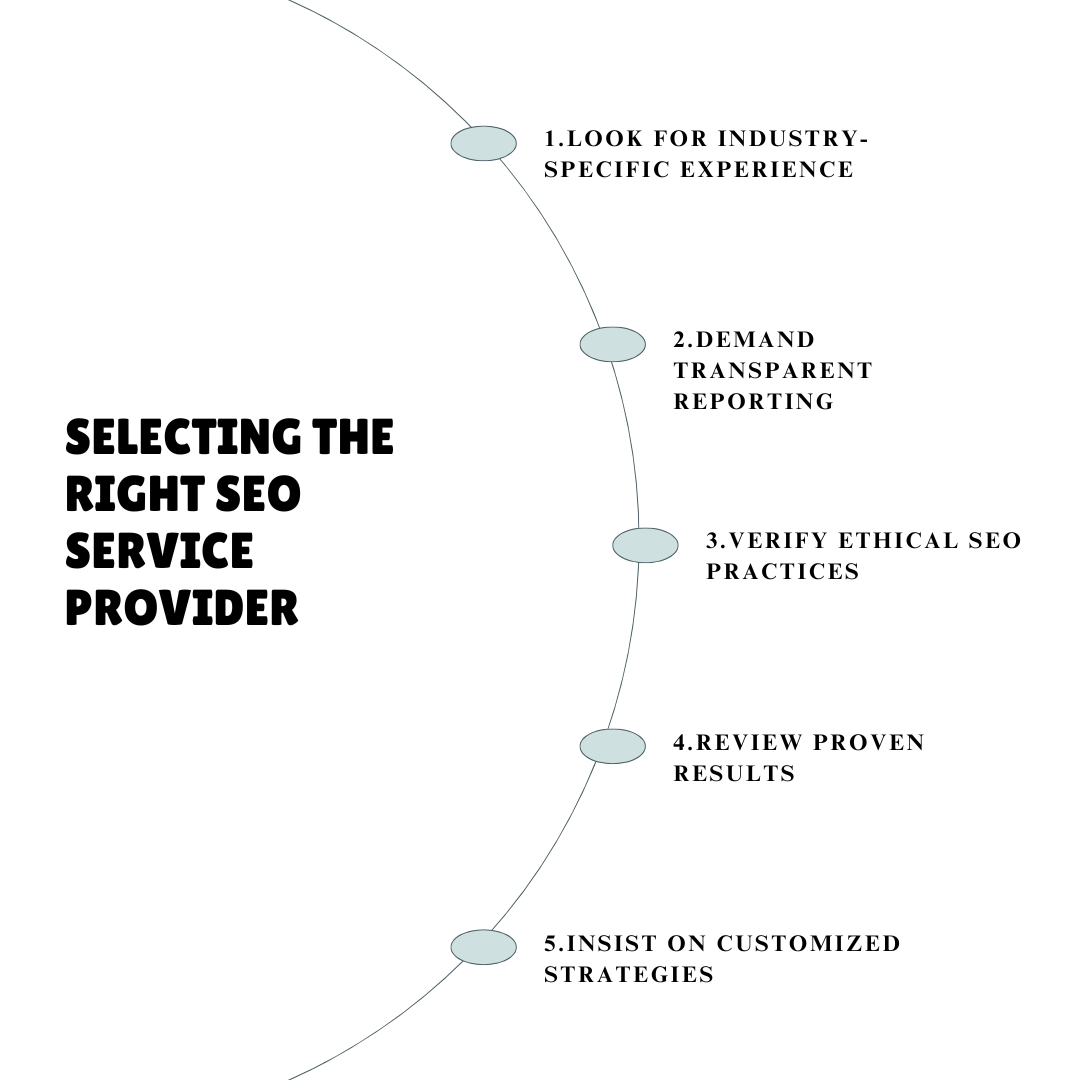
Demand industry-specific experience: An agency that can articulate the difference between YMYL compliance and standard on-page SEO, explain bar advertising rules in your state, and name the specific technical requirements for legal schema markup has genuine experience. One that cannot be guessed.
Require transparent, granular reporting: Acceptable metrics include: keyword rankings for specific practice-area terms by geography, organic traffic growth segmented by page type, and lead conversion rates (calls and form submissions). Reports showing only "visibility scores" or "domain authority improvements" without tying data to actual business outcomes are not reporting they are deflection.
Verify ethical practices: Request a link audit of any site they have built in the legal space. Check for purchased links, fake review profiles, or doorway pages targeting location variations. Google's documentation on link spam policies is explicit violations resulting in manual penalties that can take six to eighteen months to recover from.
Evaluate proven results with specificity: Case studies should show before-and-after rankings for actual competitive terms, traffic growth from legal client segments, and ROI calculations tied to client acquisition cost. "We increased traffic by 200%" is meaningless without context: what keywords, what market, what conversion rate?
Insist on a customized strategy: Personal injury firms require local + video SEO with strong client story content. Corporate attorneys benefit from LinkedIn integration and whitepaper-driven content. Solo practitioners need hyper-local Google Business Profile work above everything else. Any agency proposing identical playbooks across these different practice types does not understand the variables involved.
Our digital marketing team builds strategies specific to practice area, jurisdiction, and firm size not templates recycled across clients.
DIY vs. Professional Attorney SEO: The Honest Comparison
Factor | DIY Attorney SEO | Professional Attorney SEO |
Monthly Cost | $200–$800 (tools + time) | $1,500–$8,000+ (agency retainer) |
Time Required | 15–25 hrs/month | Near-zero attorney time |
Keyword Research Accuracy | Limited without pro tools | Full competitive data |
Local SEO Execution | Basic GBP management | Full citation, review, and map pack strategy |
Technical SEO | Difficult without developer | Included |
Content Production | Requires attorney time to write or oversee | Agency-managed |
Time to Results | 6–18 months | 3–9 months with experienced team |
Risk of Mistakes | High (keyword stuffing, penalty exposure) | Low with reputable partner |
The honest assessment: DIY SEO is viable for small practices in low-competition markets with a principal who has genuine digital marketing knowledge. For firms in competitive metro markets targeting terms where the top 3 results have 200+ referring domains, professional execution is not optional, it is the price of entry.
Measuring ROI: The Metrics That Actually Matter
Traffic Quality Over Traffic Volume
Total sessions is a vanity metric. What matters is "engaged sessions" visitors spending 60+ seconds on your site, reading multiple pages, and taking a contact action. A site attracting 500 qualified visitors per month with a 4% conversion rate (20 leads) outperforms one driving 5,000 sessions with a 0.2% conversion rate (10 leads).
Conversion Attribution
Install UTM parameters on every traffic source to identify which specific keywords and pages drive form submissions and phone calls. Without this data, you cannot make informed budget decisions. Most law firms underinvest in this setup and then cannot determine what their SEO is actually returning.
Competitive Benchmarking
Track your rankings against 3–5 direct local competitors using tools like Ahrefs or Semrush. Knowing you rank #7 for "personal injury attorney [city]" is less useful than knowing that your closest competitor ranks #2 with 47 referring domains because now you have a concrete gap to close with a specific link-building target.
Client Acquisition Cost
The ultimate ROI metric for a law firm is cost per acquired client from organic search. If your SEO investment is $3,000/month and organic search drives 8 signed clients per month with an average case value of $8,000, your return is calculable and defensible. Build this calculation from month one.
5 Common Attorney SEO Mistakes and How to Fix Them
1. Keyword stuffing: Repeating "personal injury attorney" seventeen times in a 600-word page does not increase rankings; it triggers spam signals. Fix: write for the reader, integrate keywords where they read naturally, and target 1–2% density.
2. Ignoring local SEO entirely: A law firm website optimized only for generic terms misses the entire high-intent local search market. Fix: build geo-modified service pages, complete your Google Business Profile to 100%, and create a review acquisition process.
3. Non-mobile-friendly design: A site that functions poorly on a phone generates high bounce rates, which suppresses rankings. Fix: test your site on an actual mobile device, not just a browser's responsive preview. Legal searchers on mobile expect tap-to-call functionality prominently placed.
4. Thin or generic content: A 400-word page explaining "what is a personal injury lawyer" provides no competitive advantage. Fix: build comprehensive practice area pages that address specific local statutes, common case scenarios, and the firm's demonstrated track record.
5. No performance tracking: Without Google Search Console, Google Analytics 4, and call tracking in place, you have no way to know whether your investment is working. Fix: install all three before spending a dollar on SEO. Measure before you optimize.
Conclusion
The law firms ranking on page 1 for high-value terms in your market are not there by accident. They made a deliberate decision to invest in attorney SEO services and they started before their competitors did. The strategies in this guide strategic keyword research, on-page optimization, local SEO, authority content, ethical link building, and technical performance are not optional components. They are the complete picture. Firms that execute all six, consistently, in competitive markets, win.
Ready to Rank Your Law Firm Above Competitors?
We have helped firms in competitive markets build first-page rankings for practice-area terms that drive real client inquiries, not just traffic.
Here is what you get from our free audit:
A ranked list of keyword opportunities your firm is currently missing
A technical assessment of your site's current performance gaps
A local SEO gap analysis against your top 3 competitors
A 90-day priority action plan
Audits are completed within 5 business days. No commitment required. Get My Free SEO Audit
FAQ
What are attorney SEO services exactly?
Attorney SEO services are search engine optimization strategies tailored specifically for law firms. They include keyword research targeting legal intent queries, on-page optimization for practice area pages, local SEO to rank in the map pack, content marketing to build topical authority, ethical link building, and technical SEO to ensure proper crawling and indexing. The goal is to rank your firm in front of potential clients at the exact moment they search for legal help.
How long does it take to see results from law firm SEO?
Most law firms begin seeing measurable ranking improvements within 3–6 months of consistent SEO work. Highly competitive markets in major cities, high-volume practice areas like personal injury can require 9–12 months to break into the first page. The firms that build the most sustainable long-term organic traffic are those that start early and maintain consistent execution rather than looking for shortcuts.
How much do attorney SEO services cost?
Professional attorney SEO services typically range from $1,500 to $8,000+ per month depending on market competitiveness, the number of practice areas targeted, and the scope of content production. Firms in smaller markets with lower competition will see results at the lower end of this range. Cost-per-acquired-client, not monthly spend, is the correct metric for evaluating ROI.
What is the most important SEO factor for law firms in 2026?
Demonstrating genuine expertise through comprehensive, authoritative, locally relevant content combined with a fully optimized Google Business Profile and clean technical performance. Google's EEAT standards have raised the bar for legal content specifically. Generic content no longer ranks; specific, attorney-attributed content that demonstrates real knowledge of local law and procedure does.
Should we focus on organic SEO or Google Ads?
Both serve different functions. Google Ads provide immediate visibility for high-intent terms while your organic rankings develop. Organic SEO builds a compounding asset that does not carry per-click costs. The optimal approach for most firms is to run targeted paid campaigns for your highest-value practice areas while building organic authority in parallel then scale back paid spend as organic positions strengthen. A firm relying entirely on paid search is renting its client pipeline, not owning it.
Does attorney SEO violate bar association rules?
Done correctly, no. Attorney SEO that follows ethical guidelines, no false claims, no guarantees of outcomes, no misleading comparative statements complies with bar advertising rules in all U.S. states. The tactics that create compliance risk are the same ones that create SEO risk: fabricated reviews, misleading claims, and manipulative content. Ethical SEO and ethical legal marketing are aligned, not in conflict.