
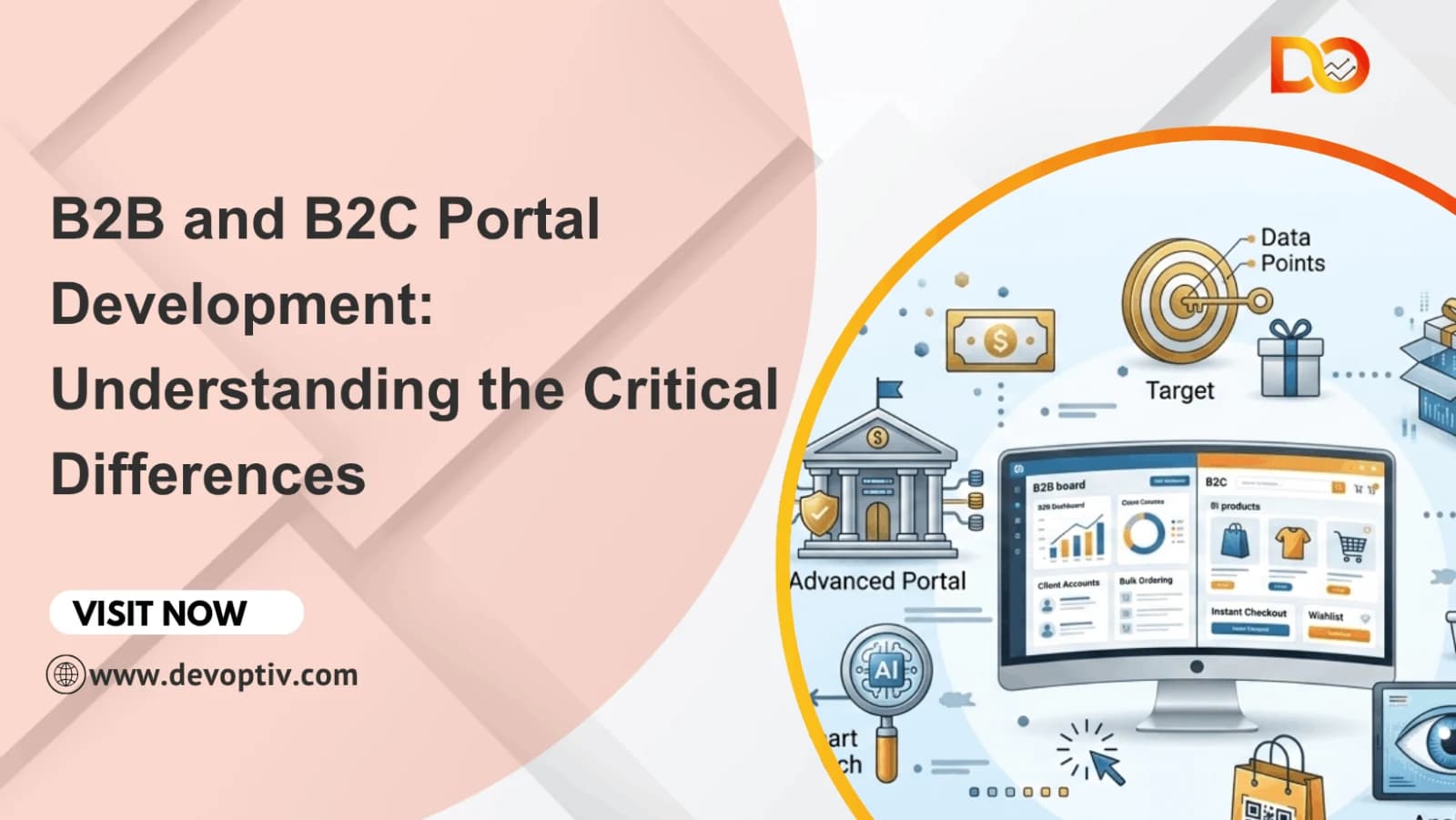
Choosing between B2B and B2C portal development is one of the most consequential technology decisions a business will make and it goes far deeper than simply knowing who your customer is. The architecture, feature set, integration landscape, and user experience philosophy behind each model are fundamentally different. Getting this wrong does not just create a bad product; it creates an expensive one that requires rebuilding from scratch.
The scale of what is at stake makes this decision urgent. The global B2B and B2C e-commerce combined market is projected to reach $38.5 trillion in 2025, with B2B representing 83.3% of that total. Meanwhile, B2C e-commerce online sales accounted for nearly 21% of global retail for the first time in 2025, with mobile projected to drive 60% of all e-commerce sales by 2026. Both markets are enormous and both demand purpose-built digital infrastructure to compete in them.
This guide breaks down every meaningful distinction between B2B and B2C portal development, covering user behavior, technical architecture, integration requirements, hybrid strategies, and what to expect in terms of cost and complexity.
The Fundamental Difference: Who Is Buying and Why
Before diving into technical specifics, understanding the behavioral difference between B2B and B2C buyers is essential because every downstream design and architecture decision flows from this starting point.
B2C portals connect businesses directly with individual consumers. Think of platforms like Amazon, Netflix, or any online retailer serving everyday shoppers. Purchasing decisions in this model are personal, often emotionally driven, and frequently made by one person within minutes.
B2B portals facilitate transactions between companies, one business selling to another, which may then serve its own customers. B2B customers often take longer to make a purchase because the buying process involves multiple decision-makers within a company, whereas B2C customers tend to make purchases more quickly as the buying process is typically limited to a single decision-maker.
This behavioral divide shapes everything from page layout to backend logic. A B2C portal is optimized to help one person fall in love with a product in 30 seconds. A B2B portal is optimized to help a procurement team justify a six-figure purchase across multiple approval layers over six weeks.
Key Feature Differences in B2B vs B2C Portals
Pricing and Payment Architecture
This is where the two models diverge most dramatically at the feature level.
B2C pricing is universal and transparent. Every visitor sees the same price. Payment options are standardized credit cards, digital wallets, buy-now-pay-later services. The checkout experience is optimized for speed and simplicity.
B2B pricing is a different animal entirely. Contracts, negotiated volume discounts, tiered pricing based on account status, and customer-specific rate cards mean that two companies buying the same product can see completely different prices when they log in. Payment terms extend beyond the transaction itself, with net-30, net-60, and net-90 arrangements, purchase orders, credit limit management, and complex multi-line invoicing all requiring dedicated system logic.
A simple "Buy Now" button cannot carry the weight of a B2B transaction. The pricing engine itself is a significant development investment.
User Experience and Decision-Making Flow
B2C users are browsing with variable intent. They need to be engaged, inspired, and guided toward a decision. Rich product imagery, customer reviews, personalized recommendations, live chat, and an intuitive search experience all serve this goal. The interface is designed to reduce friction at every step and make the path from discovery to purchase as short as possible.
B2B users are not browsing for enjoyment, they are at work, completing job requirements under time pressure. B2B buyers now demand the ability to complete tasks on their own, making self-service at every stage of the journey mandatory, not optional. They need detailed product specifications, bulk ordering tools, quick reorder functionality, saved order lists, approval workflow visibility, and documentation access. The experience is measured not by delight but by efficiency.
Critically, 87% of B2B customers are willing to pay more for a personalized experience, and 39% cite lack of customization as a top frustration. This means B2B portals must deliver personalization but operationally, not aesthetically.
Order Volume and Transaction Complexity
A typical B2C transaction involves one to five items, a single payment, and standard shipping. Simple cart, streamlined checkout, done.
A B2B transaction can involve hundreds or thousands of line items across multiple SKUs, real-time inventory checks against multiple warehouses, complex freight logistics, multi-level purchase authorization, and automatic ERP synchronization all triggered by a single order. McKinsey's B2B Pulse data shows that 73% of B2B buyers are willing to place orders exceeding $50,000 through digital self-service channels. The portal must be built to handle that weight reliably.
Technical Architecture: What Works for Each Model
Integration Requirements
Integration depth is one of the clearest technical dividing lines between B2B and B2C portal development.
B2C portals typically require payment gateway integration, a marketing CRM for automation and segmentation, shipping carrier APIs, and analytics tooling. These are well-documented, widely supported integrations that most development teams can implement with reasonable speed.
B2B portals demand a fundamentally deeper integration layer:
ERP systems (SAP, Microsoft Dynamics, Oracle) for real-time inventory, pricing, and order management
CRM platforms for account-level relationship data and sales pipeline visibility
Accounting software for invoicing, payment reconciliation, and credit management
Procurement systems for approval workflow automation and purchase order processing
Supplier management platforms if operating a multi-vendor marketplace model
These integrations are not optional enhancements; they are the operational backbone of the portal. A B2B portal that cannot communicate with your ERP in real time is not a B2B portal; it is an order form.
For businesses looking to understand the full scope of what custom portal development involves at the infrastructure level, DevOptiv's web portal development services page outlines the technical capabilities behind both B2B and B2C implementations.
Scalability Architecture
B2C portals must handle high concurrency, potentially thousands of simultaneous visitors during sale events, viral product launches, or seasonal peaks. Load balancing, CDN configuration, and peak traffic management are primary engineering concerns.
B2B portals serve a smaller, predictable user base but process dramatically larger data volumes per session. A single B2B order might contain 500 line items, each with custom pricing calculations, multiple warehouses checked for stock, and multi-tier approval logic triggered all in a single transaction. The engineering challenge is computational depth, not breadth.
Security and Compliance
Both portal types require strong security foundations, but B2B portals carry additional layers of complexity. Privacy laws including GDPR for processing EU residents' data and California's CCPA/CPRA require careful compliance architecture, and the PCI DSS v4.0 standard introduced new payment security requirements that took effect in March 2025, impacting payment flows and vendor responsibilities for all online sellers.
B2B portals additionally require role-based access control (different users within the same company see different data and capabilities), detailed audit logging (who accessed what and when), and often industry-specific compliance frameworks depending on sector.
Side-by-Side Comparison
Feature | B2B Portal | B2C Portal |
Primary User | Business buyers, procurement teams | Individual consumers |
Decision-Making | Multi-stakeholder, weeks to months | Single person, minutes to hours |
Pricing Model | Contract-based, tiered, negotiated | Universal, fixed, transparent |
Payment Terms | Net-30/60/90, POs, credit limits | Cards, wallets, BNPL |
Order Complexity | Hundreds of line items, bulk orders | 1–5 items, simple cart |
UX Priority | Efficiency, self-service | Engagement, inspiration |
Integration Depth | ERP, CRM, procurement systems | Payment gateway, shipping APIs |
Scalability Focus | Computational depth per transaction | Concurrent user volume |
Approval Workflows | Required | Not applicable |
Personalization | Account-level, operational | Behavioral, aesthetic |
Development Cost | $75,000 – $400,000+ | $30,000 – $150,000 |
When You Need Both: Hybrid Portal Development
Some businesses genuinely serve both markets simultaneously selling wholesale to commercial buyers while also maintaining a direct-to-consumer channel. This is increasingly common in manufacturing, healthcare, food and beverage, and professional services. B2B is ideal for businesses working with a network of partners and agents, while B2C suits businesses looking to build a strong online brand and serve end customers directly.
Hybrid portal strategies typically take one of three forms:
Separate portals with shared backend systems: Two distinct front-end experiences, one designed for business buyers, one for consumers drawing from the same product catalog, inventory, and order management infrastructure. Best for businesses where the two audiences have very different needs and minimal overlap.
Single portal with role-based experiences: One URL, one login system, but radically different interfaces and capabilities depending on account type. A business account sees contract pricing, bulk ordering, and approval workflows. A consumer account sees standard pricing, recommended products, and express checkout. More complex to build correctly, but more efficient to maintain.
Distinct domains with integrated data architecture: Separate branded experiences (e.g., wholesale.yourcompany.com and shop.yourcompany.com) connected through a unified data layer. Provides the clearest brand separation while maintaining inventory and reporting consistency.
Each approach carries different trade-offs in development investment, ongoing maintenance complexity, and user experience quality. The right choice depends on the actual transaction volumes, degree of customer overlap, and your team's technical resources for ongoing management.
The DevOptiv Approach to B2B and B2C Portal Development
Having built portals across manufacturing, retail, healthcare, and professional services, the most consistent finding is this: the most expensive portals are the ones that started with the wrong model and had to be restructured later.
Our process starts with understanding your actual business model, who is buying, how decisions are made, what systems exist, and where the genuine complexity lives before a single line of code is written.
For B2B Portals, We Prioritize:
Complex pricing engines that handle contract-based, tiered, and volume-based pricing at the account level
Approval workflow architecture that mirrors your actual procurement authorization structure
Deep ERP and CRM integrations through both native connectors and custom API development
Bulk ordering and quick reorder capabilities that reduce friction for repeat transactions
Account-level analytics and reporting that give your sales team visibility into customer behavior and purchasing patterns
Role-based access control that manages what each user type can see, do, and approve within the same account
For B2C Portals, We Focus On:
Conversion-optimized user experiences built around removing friction at every stage of the purchase journey
Personalization and recommendation engines that surface relevant products based on behavior and purchase history
Mobile-first responsive design given that mobile is projected to account for 60% of e-commerce sales by 2026
Social proof integration including reviews, ratings, and user-generated content that build trust
Marketing automation connectivity linking your portal to email, paid media, and CRM systems for cohesive campaign execution
Peak traffic architecture that maintains performance during high-concurrency events without degradation
To explore the full range of portal types DevOptiv develops including partner portals, employee portals, and real estate portals visit our web portal development services page.
The Role of AI in Modern Portal Development
Just 31% of B2B organizations currently qualify as AI "achievers" deploying both core and advanced AI capabilities that measurably improve customer experiences compared with 41% of B2C companies. This gap represents a significant competitive opportunity for B2B portal operators who move early.
For B2C portals, AI is already table stakes: recommendation engines, dynamic pricing, personalized homepages, and predictive search are baseline expectations for competitive consumer platforms.
For B2B portals, AI is an emerging differentiator. Intelligent chatbots that handle complex procurement queries, predictive reordering that anticipates stock needs before a buyer requests a quote, and anomaly detection that flags unusual purchasing patterns before they become compliance issues, these capabilities are moving from advanced features to competitive requirements.
DevOptiv integrates AI capabilities into portal builds where they deliver measurable operational benefits, not as a marketing checkbox but as a genuine productivity layer.
Cost Reality: What B2B and B2C Portal Development Actually Costs
Cost estimates in portal development are notoriously unreliable because complexity varies enormously. Here is a grounded framework:
B2C Portals: $30,000 – $150,000 The lower end covers well-defined scope with standard payment integration, a product catalog, and basic CMS. The upper end reflects custom personalization engines, complex product configurators, advanced analytics, and multi-region/multi-currency requirements.
B2B Portals: $75,000 – $400,000+ The floor reflects a well-scoped project with limited integrations. The upper range and beyond reflects deep ERP integration, custom pricing engine development, complex approval workflow architecture, multi-account hierarchy management, and enterprise security requirements. Choosing a B2C platform and attempting to bolt on B2B features later typically increases costs by 20–35% making upfront architectural clarity one of the highest-ROI decisions in the process.
Hybrid Portals: Budget for Both, Plus Integration Overhead If you are serving both markets, plan for the cost of each model plus the additional investment of integrating shared systems correctly. This is not a place to cut corners. Integration debt is among the most expensive technical debt to carry.
Conclusion
The distance between a B2B portal and a B2C portal is not a matter of scale, it is a matter of fundamental purpose. One is built to help individual people discover and purchase. The other is built to help organizations procure, manage, and govern complex commercial relationships at scale. Treating them as variations of the same product is what leads to portals that do neither job well.
Understanding these distinctions before development begins is not just strategically valuable, it is financially essential. The architecture decisions made in the first few weeks of a portal project compound across the entire lifetime of the system.
Whether you are building a B2B procurement platform, a B2C shopping experience, or a hybrid solution that serves both, DevOptiv brings the technical depth and sector experience to build it right the first time.
Ready to get started?
📧 Email: [email protected]
📞 Phone: +1 (657) 686-6729
🌐 Website: devoptiv.com
Request a free consultation to discuss your requirements and receive a tailored development roadmap.
Frequently Asked Questions
Should I build separate B2B and B2C portals?
If both markets represent meaningful revenue, separate portals typically deliver better user experiences because the needs are so different. B2B buyers do not want to navigate a consumer-focused interface, and B2C shoppers do not need bulk ordering tools cluttering their journey. Shared backend systems can reduce maintenance complexity significantly. The decision ultimately depends on your transaction volumes in each segment, the degree of customer overlap, and your internal capacity to maintain two front-end experiences. Our team at DevOptiv can help you model the trade-offs during a free consultation.
How long does portal development take?
A straightforward B2C portal with a clear scope can reach launch in 8–14 weeks. A B2B portal with deep ERP integration and custom workflow development typically requires 16–32 weeks or more. Hybrid implementations extend timelines further. Rushing architecture decisions to hit an arbitrary launch date is one of the most common and most expensive mistakes businesses make.
Can I start with one model and add the other later?
Yes, but architecture planning at the outset is essential. Building a B2C portal and later adding B2B capabilities is more manageable than the reverse, because consumer-facing systems tend to have simpler data models that can be extended. However, the right approach is to plan for both from day one even if you only build one initially. This means ensuring your data architecture supports multiple pricing models, complex user roles, and enterprise integrations before they are needed.
What makes B2B portal development more complex and more expensive?
The complexity comes from the intersection of several factors: multi-stakeholder decision-making that must be encoded into approval workflows, contract-based pricing that changes per account, deep integration requirements with existing enterprise systems, role-based access control across organizational hierarchies, and regulatory compliance for sensitive commercial data. Each of these is a meaningful engineering investment individually. Together, they explain why a well-built B2B portal costs significantly more than a consumer shopping experience.