
Devoptiv
March 25, 2026
|10 min to read
|
The average first-time founder spends between $30,000 and $80,000 building their MVP. The average first-time founder does not get a second investment check after that.
That is not a coincidence.
The money didn't disappear because the idea was bad. It disappears in the gap between what founders think software development costs and what software development actually costs when it goes wrong. Scope creep, wrong hires, no validation milestones, tech stacks built for companies ten times your size these are not rare edge cases. They are the default.
This post is not inspirational. You will not read about Airbnb or Dropbox. What you will read is a specific breakdown of the six mistakes that destroy MVP budgets, followed by a point-by-point explanation of why professional MVP development services exist specifically to prevent them and a five-question audit you can run on your own build before you write a single check.Real number: According to CB Insights, 35% of startups fail because there was no market need for a problem that a disciplined MVP process is designed to expose before you spend six figures.
The Six Mistakes That Drain MVP Budgets
Read this grid slowly. If you are honest with yourself, you will recognize at least two of these boxes.
The Mistake | What Actually Happens | Avg. Cost | |
1 | Scope Creep Before Line One | Adding “just one more feature” before writing code inflates specs, timelines, and burn. Most founders don’t notice until the first invoice arrives. | $8,000–$20,000 |
2 | Building for Imaginary Users | Designing for a customer segment you've described but never interviewed. Discovery calls cost $0. Rebuilding a product because nobody wanted it costs everything. | $15,000–$40,000 |
3 | Hiring the Wrong Dev Team | The cheapest bid wins the contract. Six months later, you own 40,000 lines of unmaintainable code and a 3-month rewrite estimate. | $20,000–$60,000 |
4 | Skipping Validation Milestones | Building in silence for months, then launching to silence. Without staged validation checkpoints, you discover the fatal flaw at go-live, not week two. | $10,000–$30,000 |
5 | Overengineering the Tech Stack | Choosing microservices and Kubernetes for an app that has 11 users. Complexity compounds cost. The right stack for an MVP is almost always boring. | $12,000–$35,000 |
6 | No Clear Definition of “Done” | Without a written MVP definition agreed upon before build, “done” keeps moving. Every moving goalpost costs you a sprint and your sanity. | $5,000–$15,000 |
Total potential damage: $70,000–$200,000 across all six mistakes. More importantly, 12–18 months of your life and a company that never found out if it could work.
The good news: none of these mistakes are novel. They have been made thousands of times before. And each one has a known solution.
Why Founders Still Make These Mistakes
It is worth pausing here, because the natural reaction to the grid above is: 'I would never do that.'
You would. Here's why.
You are too close to your own idea.
Every feature feels essential when it's your idea. Scope creep doesn't feel like a mistake when you're inside it, it feels like improving the product. The bias is structural, not a character flaw.
Development timelines are invisible until they're not.
When a developer says 'two weeks,' they mean two calendar weeks with no bugs, no blockers, no scope additions, and no holidays. That almost never happens. The first time you see a real sprint slip by six days, you understand why.
The market for 'cheap development' hides its true cost.
A $25/hour developer from a bidding platform looks like a bargain. The hidden costs of rewrites, debugging, missed requirements, documentation that doesn't exist routinely push the true hourly cost past $80. You don't know this until month four.
Validation feels optional when you're excited.
Every founder believes in their product. That belief is a feature, it is what gets you through hard weeks. But it's also what makes it easy to skip the 10 user interviews that would tell you nobody wants what you're building.Bottom line: The mistakes above are not failures of intelligence. They are failures of process. The fix is not to try harder, it is to use a process designed to catch them.
What MVP Development Services Actually Deliver (And What They Don't)
Before we get to the prevention table, let's be precise about what you're actually buying when you engage professional MVP development services.
What you are buying:
A discovery process that validates your problem before code is written
A scoped, costed, and signed definition of what will be built
A tech stack recommendation designed for speed and future scalability, not complexity
Staged milestones with real go/no-go decision points
A handoff package: clean code, documentation, and a system a second developer can maintain
Time savings of 40–60% compared to assembling and managing a freelance team yourself
What you are not buying:
A guarantee that your idea will work in the market
Unlimited revisions or scope changes at the original price
A team that will stay on your payroll forever
Permission to skip the hard founder work talking to customers, defining your value proposition, making product decisions
The best MVP development partners tell you all of this upfront. If an agency promises you guaranteed success or never mentions what's out of scope, run.Cost context: Professional MVP development services in 2024 typically range from $15,000–$80,000 depending on complexity, timeline, and geography of the team. The right question is not 'How do I spend less?' It's 'What does it cost me if this fails?'
How MVP Development Services Prevent Each of the Six Mistakes
This is not a new argument. This is the resolution of the tension we built in Section 02. Here, one for one, is how a professional MVP development process eliminates each of the six budget killers above.
Here’s your content structured into a clean, conversion-focused table:
Mistake It Prevents | How a Professional MVP Partner Prevents It | |
1 | Scope Creep | An experienced MVP development partner enforces a “core loop first” constraint. They create a one-page scope document before any ticket is written. Changes require upfront sign-off and cost estimates not after the sprint. |
2 | Building for Imaginary Users | Strong MVP teams start with a discovery sprint. No code is written in week one. Instead, they interview 10 real users and document actual pain points. Development only begins after the problem is validated. |
3 | Wrong Dev Team | Professional MVP teams provide references, auditable codebases, and clear handoff documentation. You're not hiring a random freelancer, you are investing in accountability and proven systems. |
4 | No Validation Milestones | A structured MVP process is broken into stages: prototype → user testing → build → soft launch. Each stage includes a go/no-go decision, helping you catch critical issues early at $5K, not $50K. |
5 | Overengineered Stack | Experienced developers actively push back on unnecessary complexity. They recommend simple, scalable tech and help you avoid wasting weeks on overbuilt infrastructure. |
6 | No Definition of Done | Before development begins, a clear MVP definition is documented and signed. It outlines core user flows, acceptance criteria, and explicit exclusions eliminating ambiguity and scope drift. |
The pattern is consistent: every mistake is a process failure. Every prevention is a process solution. This is why the right professional MVP partner does not save you money by being cheap, they save you money by being methodical.
How to Choose the Right MVP Development Partner
Not all MVP development services are equal. Here are the five questions to ask before signing any agreement:
Can you show me three MVPs you've built in the last 18 months with post-launch outcomes?
Portfolios are marketing. References are data. Any credible MVP agency should be able to connect you with founders who will tell you, honestly, how the engagement went.
What is your discovery process, and what does it produce?
The answer should include: user interviews or equivalent validation, a written scope document, a tech stack recommendation with rationale, and a milestone plan. If discovery is a 30-minute call before a proposal, that's a red flag.
How do you handle scope changes mid-build?
The honest answer is: carefully, with written change orders and cost estimates. If the answer is 'we're flexible,' that flexibility will cost you $10,000–$30,000 in untracked additions.
What does your handoff package include?
You should receive: clean, documented code; a README that explains the architecture; credentials and access for all tools and environments; and at minimum a one-hour walkthrough. If they haven't thought about this, you don't own your own product.
What is your definition of a successful MVP?
A credible answer is specific: a working product that tests a defined hypothesis with real users. A vague answer ('a product you're proud of') tells you they're not thinking about your business, they are thinking about their deliverables.
The 5-Question MVP Readiness Audit
Before you engage any MVP development services or before you continue building if you've already started, run this audit. It takes five minutes. If you can't answer yes to all five, you are not ready to build.
The Question | If the Answer Is No... | |
Q1 | Can I describe my MVP in one sentence — the user, the action, and the outcome? | If not, your scope is not ready for development. |
Q2 | Have I spoken to at least 10 people who match my target user profile in the last 60 days? | If not, you're building for assumptions, not evidence. |
Q3 | Do I have a written document that lists what the MVP will NOT include? | If not, scope creep is already scheduled. |
Q4 | Can I name the three core user actions that define “success” for this product? | If not, you have no finish line and neither does your dev team. |
Q5 | Do I have a signed agreement with my development team that includes a definition of “done”? | If not, you're building on a handshake, not a contract. |
Score: 5 out of 5 = ready to engage an MVP development partner. 3–4 = you have work to do first, and a good partner will help you do it. 0–2 = stop. You are about to spend serious money on a build that is not ready.
What a Well-Run MVP Process Actually Looks Like
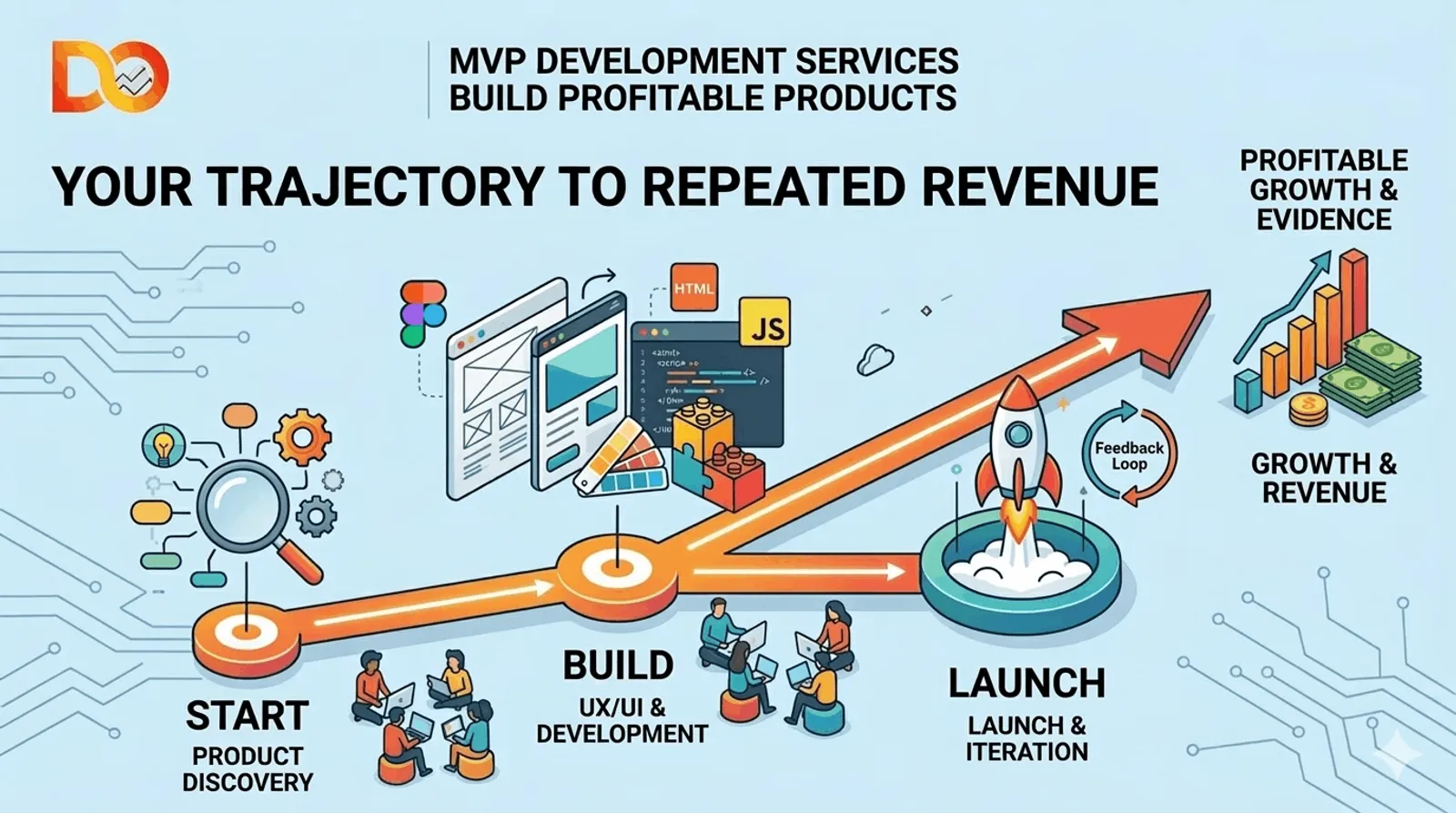
For concreteness, here is a reasonable 10–12 week MVP development timeline when the process is working:
Phase | Duration | What Happens |
Discovery & Validation | Weeks 1–2 | User interviews, problem validation, competitive analysis, and a signed scope document. |
Architecture & Design | Week 3 | Tech stack finalized, wireframes approved, and design system established. No coding yet. |
Sprint 1: Core Loop | Weeks 4–6 | The most critical user flow is built and made testable. First internal review conducted. |
Sprint 2: Secondary Flows | Weeks 7–9 | Supporting features, integrations, and admin dashboard (if needed). User testing begins. |
QA & Bug Fixing | Week 10 | Dedicated testing sprint focused only on identifying and fixing issues. No new features added. |
Soft Launch & Handoff | Weeks 11–12 | Controlled release to real users, monitoring setup, and complete handoff documentation delivered. |
This is not a fantasy timeline. It is achievable when scope is clear, decisions are fast, and feedback loops are tight. The difference between this and a 9-month nightmare is almost entirely the quality of the discovery phase and the discipline of the scope document.
The Real Cost of Getting This Wrong
Let's close with numbers, because that's where we started.
If you make all six mistakes: $70,000–$200,000 in direct costs. 12–18 months of time. A codebase you may not be able to sell, hand off, or scale.
If you engage the right MVP development services: $5,000–$80,000. 10–14 weeks. A working product, clean code, real user feedback, and a company with something to show investors.
To know more about cost read our full MVP Development Complete Cost Guide.
The difference is not just money. It's the difference between having a validated product at month three and discovering at month twelve that nobody wanted what you built.
The founders who get this right are not smarter than the ones who don't. They just stopped treating the process as optional.
Ready to Build Your MVP the Right Way?
Most founders spend $30,000–$80,000 learning lessons that are free to read. Stop burning the runway. Book a Free MVP Strategy Call
Or, if you're not ready for a call yet and want to know more about it:
Read our post: 'MVP Development Services for Startups & Enterprises: How to Build a Profitable MVP'