
You have a brilliant idea. Maybe it is a mental health platform, a FinTech tool, or the next SaaS product your industry desperately needs. But before you build the whole thing, you want to test the waters - intelligently, efficiently, and without burning through your entire budget.
That is exactly what an MVP (Minimum Viable Product) is for.
But here is the question every founder, startup, and product team asks at the very beginning: what is the real MVP development cost?
The answer is not a single number. It is a range from $5,000 for a lean, basic product to $250,000+ for a complex, compliance-heavy platform. And understanding what drives that range is what separates founders who invest wisely from those who overspend or underbuild.
In this complete guide, we break down everything - cost factors, process steps, industry-specific pricing, and what to expect at every budget level. By the end, you will know exactly what your minimum viable product cost should look like and how to get the most from every dollar you invest.
What Does MVP Development Actually Cost?
MVP development cost varies significantly based on what you are building, who builds it, and how fast you need it. Here is the high-level cost landscape for 2026:
Budget Range | MVP Type | What to Expect |
$5,000 – $10,000 | Basic Web/Mobile MVP | Core features only, one platform, limited integrations |
$10,000 – $30,000 | Mid-Range MVP | 2–3 platform coverage, moderate features, basic integrations |
$30,000 – $80,000 | Advanced MVP | Complex logic, third-party APIs, solid UI/UX, multi-role users |
$80,000 – $250,000+ | Enterprise / Regulated MVP | Full compliance (HIPAA/FinTech), AI features, high scalability |
The key insight? MVP development cost is not a fixed price, it is a reflection of scope, complexity, compliance requirements, and timeline. Let us break each of those down.
MVP Pricing Models: Which One Is Right for You?
How you structure the engagement with your development team matters as much as the headline cost.
Fixed-Price Best when your scope is clear and well-defined. You agree on a price upfront typically $5,000–$100,000 and the team delivers to that specification. Predictable budget, less flexibility if requirements change.
Time & Materials Best when requirements will evolve. You pay for hours used, typically $50–$150/hour depending on team location. Maximum flexibility, less cost predictability. Works well for startups that expect to pivot.
Milestone-Based The most balanced approach for most startups. The project is divided into phases authentication, core features, dashboard, integrations, QA with fixed deliverables and payments at each stage. You only pay for what is delivered and approved.
How DevOptiv Structures MVP Engagements
At DevOptiv we offer three models designed for different startup stages and budgets.
Full MVP Outsourcing ($5,000–$150,000+ based on scope) Our most popular model. DevOptiv manages your entire MVP lifecycle strategy, design, development, testing, and deployment. You get a launch-ready product without managing any technical resources internally. Best for founders who want end-to-end execution and peace of mind.
Hourly Engagement ($100/hour for core team + $35/hour for UI/UX) Designed for teams that want full flexibility and to pay strictly for hours used. We assign one project manager, two dedicated developers, and a UI/UX designer on an as-needed basis. You control priorities and scale the team up or down at any time.
Milestone-Based Development (pricing varies by scope) For complex products with multiple modules, we divide development into clear phases with fixed deliverables, timelines, and budgets per milestone. You pay per milestone as it is completed and approved maximum transparency, zero surprises.
6 Key Factors That Determine Your MVP Development Cost
1. Type of Product and Platform
A web application costs less to build than a native mobile app and a cross-platform app that runs on both iOS and Android costs more than either. The more platforms you want to cover at launch, the higher your MVP app development cost will be. For most early-stage startups, we recommend starting with a single platform or a responsive web app to keep costs focused.
2. Feature Complexity
A basic login, dashboard, and user profile is low cost. Add real-time chat, AI-powered recommendations, payment gateway integration, geolocation, video streaming, or multi-role permissions and your development hours multiply. Every feature adds time, and time is cost. The art of MVP development is ruthlessly cutting what is not essential for launch day.
3. Tech Stack and Architecture
Different technologies carry different price tags. Building with Laravel, MERN Stack, or Flutter each requires specific expertise. A well-chosen tech stack can actually reduce your long-term cost for example, choosing a scalable backend architecture from day one prevents expensive rewrites later. At DevOptiv, we select the stack based on your scalability goals, not just short-term convenience.
4. Timeline and Speed of Delivery
Need it in six weeks? That means more developers working in parallel which means higher cost. Have a flexible four-to-five-month runway? That allows for a more methodical approach with a leaner team and optimized budget. Speed and cost are inversely related in software development. Plan your timeline carefully.
5. Industry and Compliance Requirements
This is one of the most underestimated cost drivers. If you are building in healthcare, FinTech, or mental wellness, your MVP must comply with industry regulations - HIPAA, PCI-DSS, GDPR, and similar frameworks. This means additional security architecture, encrypted storage, audit logging, consent management, and thorough testing. The cost to develop a holistic mental health app MVP, for instance, is typically 30–50% higher than a standard consumer app because of these compliance and data privacy requirements.
6. Post-Launch Support and Scaling Plans
An MVP without a plan is a prototype without a future. Budget planning should include what happens after launch - bug fixes, performance monitoring, feature iterations, and eventual scaling. A good MVP development company will factor these costs into your roadmap from the start.
MVP Development Cost by Industry: Healthcare, FinTech & More
Not all MVPs are created equal. Industry context dramatically changes what your minimum viable product cost will look like. Here are three of the most common verticals we work in at DevOptiv:
Cost to Develop a Holistic Mental Health App MVP
Mental health platforms deal with extremely sensitive personal data. To build responsibly and legally, your MVP needs end-to-end data encryption, HIPAA-compliant infrastructure, consent flows, and secure therapist-patient communication channels. Add features like mood tracking, journaling, appointment booking, or AI-based recommendations and you have a meaningful product that comes with a meaningful price tag. Expect the cost to develop a holistic mental health app MVP to range from $40,000 to $120,000+ depending on feature depth and compliance requirements.
MVP Development Cost for FinTech Apps
Financial applications require PCI-DSS compliance, bank-grade security, fraud detection mechanisms, and often third-party integrations with payment processors or open banking APIs. A FinTech MVP typically ranges from $50,000 to $150,000+, depending on whether you are building a budgeting tool, a lending platform, or a crypto exchange.
Standard Consumer App MVP
A non-regulated consumer application think marketplace, social platform, productivity tool, or e-commerce MVP can be built for as little as $10,000 to $50,000 with the right scope discipline. This is where most first-time founders start, and where DevOptiv helps clients get maximum value.
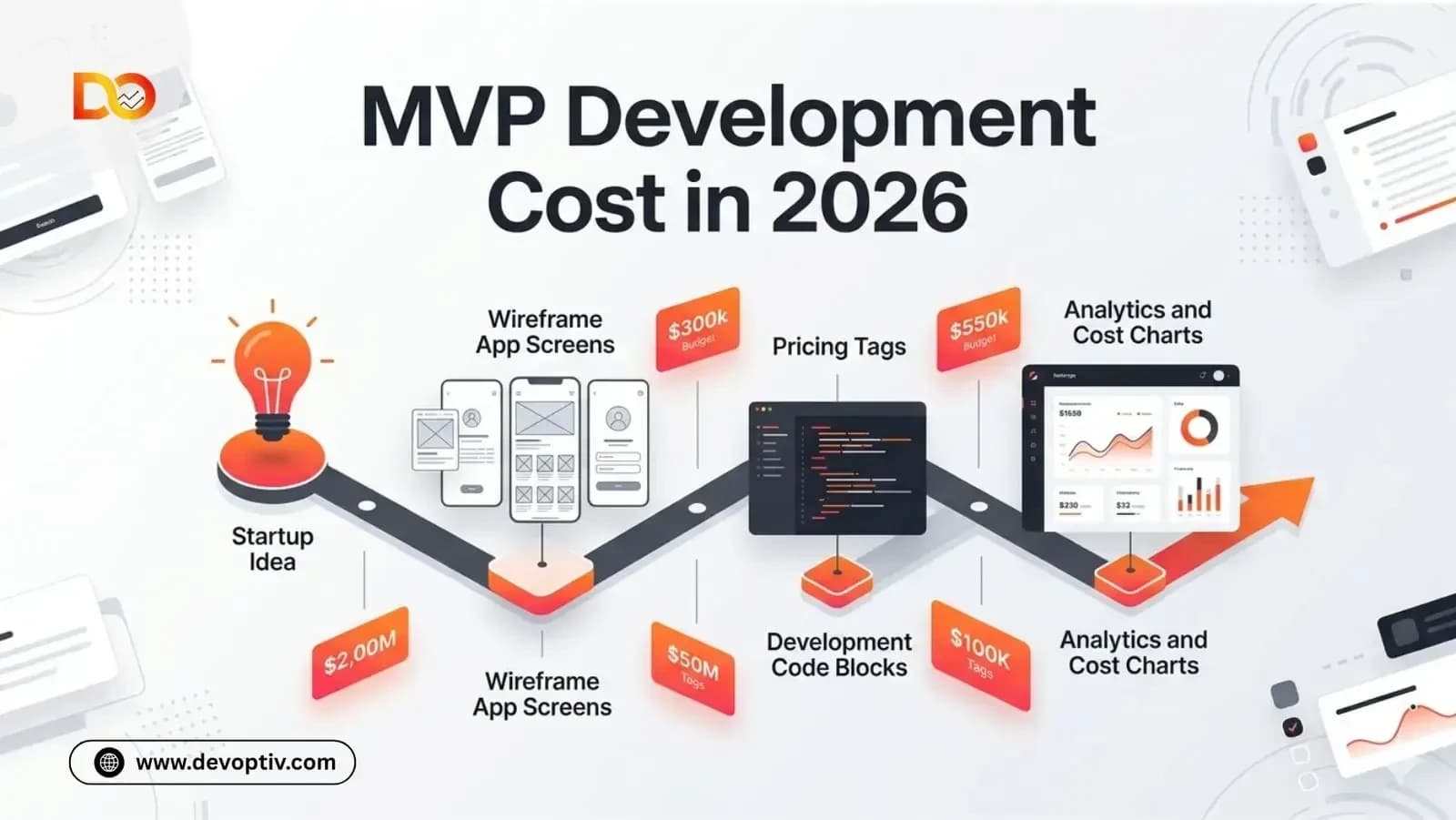
The MVP Development Process: Step-by-Step Timeline & Costs
Understanding the mvp development process helps you understand where your budget goes. Here is how DevOptiv structures a typical MVP engagement, and how long each phase takes:
Step 1: Ideation & Feasibility Check (Weeks 1–2)
Before a single line of code is written, we validate your concept. This phase includes market research, competitor analysis, feature prioritization workshops, and technical feasibility assessments. The goal is simple: confirm this idea is worth building before you invest heavily. Cutting a feature at this stage costs zero dollars. Cutting it after development costs thousands.
Step 2: Prototyping (Week 2–3)
We map the core user flows with wireframes low-fidelity visual blueprints showing how users move through your product. This is where assumptions become something tangible you can test, share with investors, and gather early feedback on.
Step 3: UI/UX Design (Weeks 3–4)
Design and development often run in parallel at DevOptiv to save time. Your user interface is not just aesthetics, it is trust. A polished, intuitive MVP converts better, earns more user retention, and makes a stronger impression on investors. We design with your brand identity and target user in mind.
Step 4: Development (Weeks 4–8+)
This is the core build phase - backend infrastructure, frontend interfaces, API integrations, database architecture, and third-party connections. Timeline and cost here depend directly on feature scope. A simple MVP can be coded in four weeks. A complex, multi-role platform with integrations could take three to four months.
Step 5: QA, Testing & Deployment (Final Week)
Before we ship, we break it intentionally. Our QA team conducts performance testing, security audits, edge-case testing, and cross-device compatibility checks. We then deploy to your live hosting environment. Minimum total mvp app development timeline: approximately 9 weeks for a basic scope. More complex builds run 16–20 weeks.
MVP Budget Breakdown: What Do You Actually Get?
This is the question every client asks and rightfully so. Here is a practical breakdown of what different budget levels unlock at DevOptiv:
MVP Development Under $10,000 - What You Get
At this budget level, you are working with tight scope discipline. Expect a single-platform web or mobile application with core user authentication, one primary feature loop, basic UI, and a simple database. Ideal for proof-of-concept stage founders who need something to demonstrate to early users or angel investors. No advanced integrations, minimal design polish.
$10,000 to $50,000 MVP Budget Breakdown
This is the sweet spot for most early-stage startups. You get a properly architected application with multiple features, clean UI/UX design, essential third-party integrations (payments, notifications, maps), and a stable backend built to scale. This range covers most consumer app MVPs and early B2B tools. DevOptiv delivers the majority of client MVPs in this range.
$50,000+ Enterprise-Grade MVP
At this level, expect full-featured applications with complex business logic, compliance infrastructure, advanced security, third-party enterprise integrations, multi-role user management, and comprehensive QA. This is the appropriate investment for regulated industries, platforms with real-time data processing, or any product where security and reliability are non-negotiable from day one.
How much should I budget for my MVP? A founder's strategy guide
Knowing what an MVP costs is only half the equation. The harder question — the one most guides skip — is: how much should you specifically spend? The answer depends on your funding stage, your market, and what you actually need to prove.
Here is a practical framework used by experienced founders and the investors who back them.
Budget by funding stage
Pre-seed / bootstrapped ($10,000 – $25,000) - Prove the concept exists and someone will use it. One platform, one core loop. Speed over polish.
Seed stage ($25,000 – $80,000) - Prove real users pay and retain. Clean UI, integrations, onboarding. Investor-ready quality.
Series A / enterprise ($80,000 – $250,000+) - Prove the model scales. Compliance, security, multi-role users, full reporting.
When to spend more on your MVP
You are in a regulated industry (healthcare, fintech, legal) — compliance cannot be cut
Your MVP will be shown to enterprise clients or investors — quality signals credibility
You are entering a competitive market where UX is a differentiator from day one
You need real-time data processing, AI features, or complex integrations to demonstrate value
Your core assumption can only be tested with a complete user journey, not a landing page
When to spend less on your MVP
Your core assumption can be validated with a landing page, waitlist, or prototype first
You are at idea stage with no customer discovery completed yet
Your market is unproven and you need to pivot fast lean is a strategic advantage
You have limited runway and need to extend it as long as possible before your next raise
How to split your MVP budget by category
Category | Recommended allocation | Notes |
|---|---|---|
Design (UI/UX) | 15–20% | Never skip this — poor UX kills retention before you can measure anything |
Backend development | 30–40% | Database, APIs, auth, core logic — the heaviest cost centre |
Frontend development | 20–25% | What users actually see and interact with |
QA and testing | 10–15% | Untested MVPs generate churn data, not learning data |
Post-launch buffer | 10–15% | Real users always surface issues your QA team did not find |
The most common mistake founders make is spending 90% of their budget on development and nothing on launch. Reserve at least 10–15% of your total MVP budget for the first month of user acquisition and iteration that is where your real learning happens.
What Happens After You Launch Your MVP?
Too many founders treat the MVP launch as the finish line. It is not. It is the starting gun. Here is what a smart post-launch strategy looks like and why it matters for your total budget planning:
Marketing & User Acquisition
Your MVP needs eyeballs. A launch strategy should include a combination of SEO, paid advertising, content marketing, and social media campaigns. Budget for user acquisition from day one. Without traffic, you cannot gather the feedback that makes your product better.
Ongoing Support & Performance Monitoring
Real users will find bugs your QA team did not. Server performance under real traffic looks different than in a testing environment. Budget for ongoing support, monitoring, and rapid bug fixes in the months following launch. DevOptiv offers dedicated post-launch support packages to ensure your product stays stable while you grow.
From MVP to Full SaaS Product
Once your MVP validates the core assumption that real users want and will pay for your solution the next step is feature enrichment. This is where you add premium tiers, subscription billing, automation workflows, advanced analytics, and enterprise capabilities. This is how an MVP to SaaS product development journey typically unfolds, and DevOptiv partners with clients through every stage of that evolution.
Why Choose DevOptiv as Your MVP Development Company?
DevOptiv is not a code factory. We are a product development partner. Here is what that means in practice:
Full-cycle capability: strategy, design, development, QA, and post-launch support under one roof
Industry expertise across healthcare, FinTech, e-commerce, SaaS, and consumer apps
Compliance experience with HIPAA, PCI-DSS, and GDPR requirements
Transparent, milestone-based pricing - no hidden costs
Dedicated project managers and direct developer communication
Scalable engagements from a $5,000 basic MVP to a $250,000+ enterprise platform
When you work with DevOptiv, you are not just getting developers. You are getting a team that thinks like founders obsessed with validating your idea quickly, smartly, and without waste.
How to evaluate MVP development agencies within a $75,000 budget
If you have a $25,000 – $75,000 budget and you're comparing MVP development agencies, this section is for you. With dozens of options ranging from offshore freelancers to mid-size agencies, choosing the wrong partner can cost you more than the build itself.
Here is a structured framework for evaluating agencies at this budget level — and the red flags that should stop any conversation cold.
What a $75,000 MVP budget should get you in 2026
Deliverable | What to expect |
|---|---|
Platforms | Web app OR mobile app (one platform, not both) |
Features | 5–10 core features with clean UX and integrations |
Timeline | 12–18 weeks from kick-off to launch |
Team | Dedicated PM + 2 developers + UI/UX designer |
Compliance | HIPAA or PCI-DSS compliant architecture if required |
Post-launch | 30–60 days of bug fix support included |
5 questions to ask every MVP agency before signing
Can you show me 3 MVPs you have shipped in the last 12 months with live URLs? — Portfolios with screenshots only are a warning sign.
How do you handle scope changes mid-project? — You will change your mind. A good agency has a clear, fair process for this.
Who owns the code and IP on day one? — It should be you, with no clauses.
What does your post-launch support look like, and what does it cost? — Agencies that disappear after delivery are the most expensive kind.
How do you price? Fixed-price, time and materials, or milestone-based? — Fixed-price sounds safe but can lead to scope cuts. Milestone-based gives the best balance of certainty and flexibility.
Red flags that should end the conversation
No dedicated project manager - developers answering client emails directly signals process problems
Proposal delivered in under 24 hours with no discovery questions they copied a template
Vague deliverables with no milestone structure - "we'll build your MVP" is not a contract
Payment terms that are 100% upfront - no legitimate agency requires full payment before any work
No mention of QA, testing, or deployment in the proposal - these are not optional
How Devoptiv compares at the $75,000 budget level
Factor | Devoptiv | Typical offshore freelancer |
|---|---|---|
Project management | Dedicated PM included | You manage the dev directly |
Design | UI/UX included in team | Extra cost or skipped |
QA | Structured QA phase | Developer self-tests |
Compliance | HIPAA/PCI-DSS experience | Rarely available |
Post-launch | Support packages available | Engagement ends at delivery |
Code ownership | 100% yours from day one | Check the contract carefully |
At the $75,000 budget level, the difference between a $40,000 agency and an $80,000 agency is rarely about code quality, it is about project management, communication, and what happens after launch. Choose on process, not just price.
Final Thoughts: Invest in Clarity Before You Invest in Code
MVP development cost is not just a number, it is a decision. The question is not 'how cheaply can I build this?' The question is: 'what is the minimum investment that gives me maximum learning and market validation?'
The founders who get the most from their MVP budgets are the ones who start with a clear problem, resist feature bloat, choose the right partner, and plan for what comes after launch.
If you are ready to turn your idea into a validated, well-built product, DevOptiv is ready to help whether you are working with $10,000 or $200,000.
Frequently Asked Questions About MVP Development Cost
Q1: How much does MVP development cost?
MVP development cost ranges from $5,000 for a basic, single-feature product to $250,000+ for a complex, compliance-heavy platform. The average mid-range MVP the type that covers a real use case with clean UI and essential integrations typically costs between $15,000 and $60,000. Factors that influence final cost include number of platforms, feature complexity, tech stack, team location, and industry compliance requirements.
Q2: Can I build an MVP under $10,000?
Yes, but only with strict scope discipline. An MVP development under $10,000 is achievable for a single-platform application focused on one core feature loop with minimal integrations and basic UI. It is ideal for proof-of-concept validation but not suitable for regulated industries or consumer-facing products that require polished design and multiple feature sets.
Q3: How long does MVP development take?
The minimum MVP app development timeline is approximately 9 weeks when design, development, and QA run efficiently. More complex projects with multiple integrations, compliance requirements, or advanced features typically take 16 to 24 weeks. Trying to compress a 20-week project into 8 weeks by throwing more developers at it usually increases cost without proportionally reducing time.
Q4: What is the best tech stack for MVP development?
The best tech stack depends on your scalability goals, team expertise, and product type. DevOptiv commonly uses Laravel for PHP-based web applications, MERN Stack for JavaScript-centric platforms, and Flutter for cross-platform mobile apps. There is no universal winner the right choice is the one that gets you to market efficiently while giving you a codebase that can scale without costly rewrites.
Q5: How much does it cost to develop a mental health app MVP?
The cost to develop a holistic mental health app MVP ranges from $40,000 to $120,000+, depending on features and compliance scope. Healthcare and mental wellness applications require HIPAA-compliant infrastructure, data encryption, secure communication channels, and careful privacy design all of which add legitimate cost. Cutting corners on compliance in this space is not a budget strategy, it is a liability.
Q6: What happens after my MVP launches?
After launch, the real work begins: user feedback collection, bug fixing, performance monitoring, marketing, and feature iteration. Most teams find that 20–30% of their original assumptions change after real users engage with the product. This is by design the MVP exists to generate that learning. Post-launch support, user acquisition strategy, and a clear mvp to SaaS product development roadmap are all part of a smart launch plan.
Q7: Does DevOptiv provide post-launch support?
Yes. DevOptiv offers dedicated post-launch support packages that include ongoing bug fixes, performance monitoring, server management, and iterative feature development. Our mvp development services are built for the full lifecycle not just the initial build. We stay with our clients from idea to scale.