
Introduction
Every founder has heard the advice to "just build an MVP."Not every founder knows what makes one MVP successful while another quickly runs out of money and fails.
This difference can determine whether a startup succeeds or fails. Building something is not the goal. The goal is building the smallest version of your product that real customers will pay for, use again, and tell other people about. This is the difference between an MVP as a checkbox exercise and an MVP as the foundation of a profitable company.
This guide walks you through the key elements of a profitable MVP: what it is, why so many startups skip the parts that matter, how much it actually costs to build one in 2026, and the specific mistakes that quietly kill profitability long before a product ever reaches scale.Whether you're building your first startup or refining an existing product idea, this guide will help you understand what makes an MVP profitable and how the right MVP development services for startups can accelerate your journey to market.
What Is an MVP? (And What It Is NOT)
A Minimum Viable Product (MVP) is the simplest version of your product that helps you test whether people actually want your idea. Instead of spending months building a full-featured product, you launch with only the core features needed to solve one important problem. The idea comes from Eric Ries and his Build → Measure → Learn approach. You build a simple product, launch it to real users, collect feedback, and use what you learn to improve it.
Why Startups Fail Without an MVP Strategy
Many people think startups fail because they run out of money, but that's usually the result of a bigger problem, not the main cause. Research by CB Insights found that 43% of startup failures happen because there isn't enough demand for the product, making poor product-market fit the biggest reason startups fail. Other common reasons include bad timing (29%) and weak business economics (19%). The research also found that many early-stage startups fail because they never build a product that the market truly wants. You can read the full breakdown in CB Insights' research on why startups fail.
This is why having an MVP strategy is so important. It helps you test your idea early, before spending months building a product that customers may not want. Instead of making assumptions, you collect real feedback and use it to make better decisions.
Without a clear MVP strategy, founders often make these mistakes:
1. They build first and validate later
Many founders believe their idea is good enough without talking to potential customers. They spend months building the product, only to discover that there isn't enough demand when they finally launch.
2. They test the product but not the business
Getting users is a good sign, but it doesn't always mean your business will succeed. If people use your product but aren't willing to pay for it, your startup still has a problem. A successful MVP should help you validate both customer interest and willingness to pay.
3. They focus only on features.
An MVP is more than a list of features. It should also answer important questions like:
What are we trying to prove?
How will we measure success?
What will we do if the results don't support our idea?
Without clear goals, teams often keep adding features even when the market has already shown that the product needs a different direction.
An MVP strategy doesn't slow down your startup. It helps you discover problems early, when they are much easier and less expensive to fix.
Benefits of MVP Development For Startups
Done properly, MVP development changes the entire risk profile of a startup, not just the timeline. Here are some benefits that matter most for startups that actually turn a profit.
1. Validates real market demand before you spend the budget
This is the single biggest benefit, and the data backs it up. CB Insights' analysis of startup post-mortems found that poor product-market fit is cited in roughly 43% of shutdowns more than any other cause. An MVP puts that assumption in front of real users in weeks instead of letting it sit untested for a year. You can see the full breakdown in CB Insights' research on why startups fail.
2. Sharply lowers the cost of being wrong
Large-scale IT projects built without proper validation don't just risk failure. McKinsey's research with the University of Oxford, covering more than 5,400 IT projects, found that on average these projects ran 45% over budget and delivered 56% less value than originally predicted. An MVP exists specifically to catch a flawed assumption before it compounds into that kind of overrun. Read the full study on McKinsey's site on delivering large-scale IT projects.
3. Faster time-to-market
A focused MVP launches in weeks or a few months, not the 12–18 months a full-scale build typically takes. That head start means you're collecting real usage data, refining messaging, and building brand awareness while competitors are still stuck in the planning phase.
4. Preserves runway and capital efficiency
By limiting scope to core functionality, an MVP costs a fraction of a full-featured build. That difference extends the runway, reduces how much founders need to raise (and dilute) before proving traction, and gives bootstrapped teams a real shot at reaching revenue before external funding becomes necessary.
5. Turns assumptions into evidence
Every line in a pitch deck is a hypothesis until real users interact with the product. An MVP replaces "we think people want this" with actual activation, retention, and usage data, the only kind of evidence that reliably predicts what happens at scale.
6. Strengthens investor and stakeholder conversations
Investors increasingly fund traction, not ideas. A working product with real usage, even at a small scale, demonstrates execution ability and de-risks the opportunity in a way that a roadmap slide or projection never can.
7. Makes pivots cheap instead of catastrophic
If early data shows the original idea needs to shift, an MVP-stage pivot costs weeks of rework. The same correction after a full-scale build can cost the company its remaining runway or the company itself.
8. Forces smarter resource allocation
Building an MVP means constantly asking "can we launch without this feature?" That discipline prevents the over-engineering and scope creep that quietly drains early-stage budgets on functionality nobody has asked for yet.
9. Builds a foundation for scale, not a dead end
A properly architected MVP, the kind delivered through structured MVP development services rather than a rushed weekend build, can expand into a full product without a ground-up rebuild once demand is proven. That's the real difference between an MVP built to validate and one built to last.
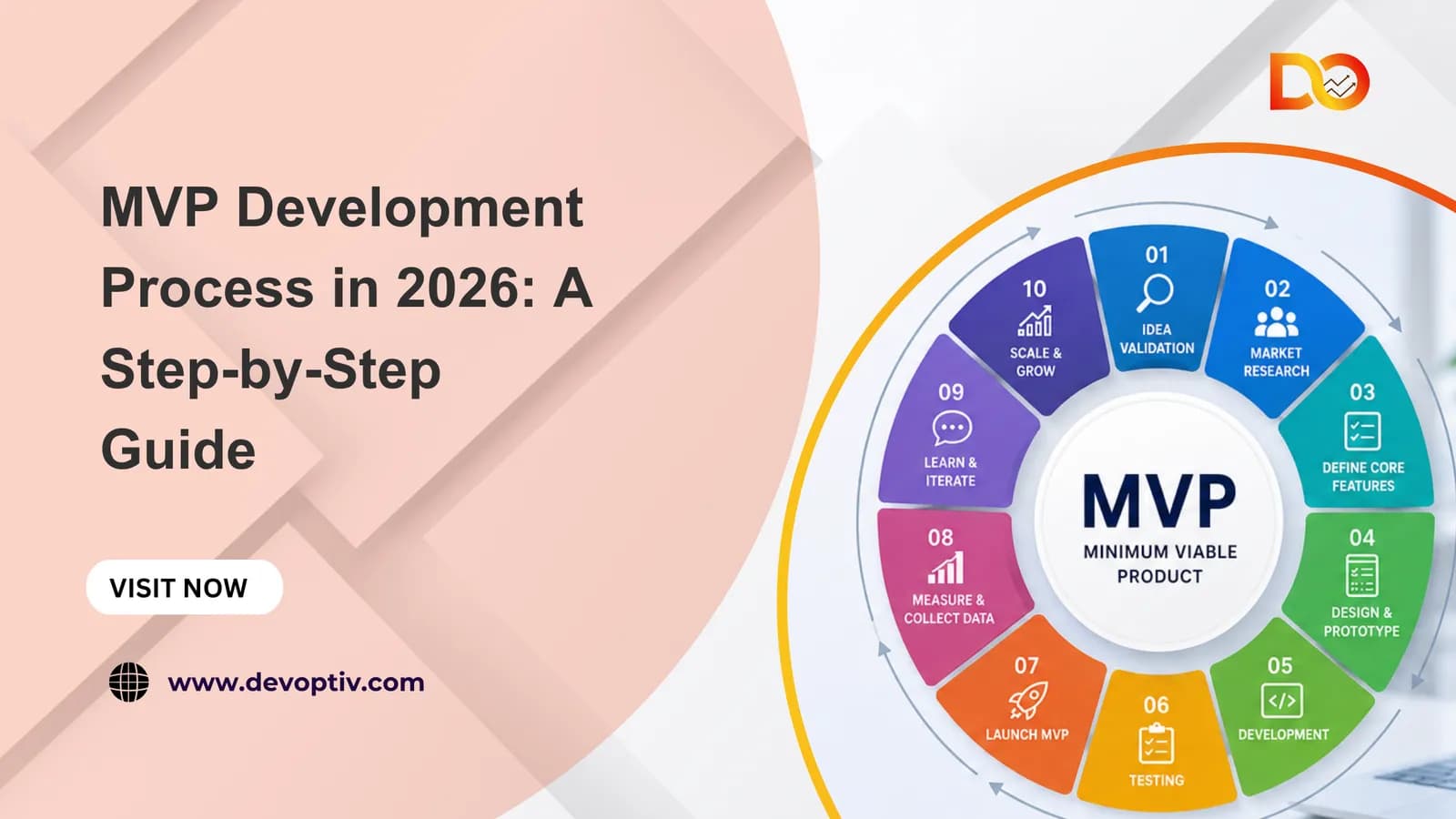
How to Build a Profitable MVP for Startup: Step-by-Step
This is where most MVP guides stop at "build fast." Profitability requires a few extra steps baked into the process from day one.
Step 1: Validate the Problem Before You Start Building
Before creating a roadmap or writing any code, talk to people who match your target audience. The goal isn't to ask, "Would you use this product?" Most people will say yes. Instead, ask questions like:
How do you solve this problem today?
What solutions have you already tried?
Have you ever paid for a product or service that solves this problem?
If people are already spending money to solve the problem, it's a strong sign that there is real demand.
Many successful startups follow this approach. Instead of spending months perfecting a product, they build a simple version, launch it quickly, and learn from real user feedback. This helps founders understand what customers actually need before investing more time and money.
Step 2: Focus on One Core Value
A successful MVP should solve one important problem really well. Trying to include too many features before launch makes development slower and makes it harder to know whether your main idea actually works. Ask yourself:
Does this feature help prove my main idea?
If yes, include it.
If not, save it for a future version.
Keeping your MVP simple helps you launch faster, gather feedback sooner, and avoid spending resources on features your users may never need. The goal isn't to build everything at once. The goal is to build the smallest product that delivers real value and proves that customers want your solution.
Step 3: Design around retention, not just acquisition
Getting users to try your MVP is only the beginning. The real goal is to build a product they keep coming back to. One simple way to measure this is the Sean Ellis Test, which asks users, "How would you feel if you could no longer use this product?" If 40% or more say they'd be "very disappointed," it's a strong sign that your MVP is solving a real problem.
Step 4: Price it from day one even roughly
Don't rely only on free signups to measure success. The best way to know if people truly value your MVP is to see if they're willing to pay for it. Even a small payment, deposit, or flexible pricing model can give you valuable insights into real customer demand. If you're not confident enough to charge, it may be a sign that your value proposition needs more work.
Step 5: Build lean, but build stable
Cutting scope is correct. Cutting code quality, security, or basic QA is not, it just moves the cost to later, with interest. A stable MVP that handles payments, auth, and data correctly from the start avoids the expensive rebuild that undoes months of user trust.
Step 6: Instrument everything before launch
You cannot learn from an MVP you can't measure. Set up analytics for activation, retention, and revenue events before the first user ever signs up. Decide in advance what numbers will tell you to keep going, pivot, or stop. This is the "measure" half of Eric Ries's build-measure-learn loop, and skipping it is the most common reason founders end up making a pivot decision on gut feeling instead of evidence.
Step 7: Launch to a narrow audience first
Resist the instinct to launch broadly. A focused early cohort ideally the people you interviewed in Step 1 gives you cleaner, more honest feedback than a wide, anonymous launch where noise drowns out signals. Graham describes this approach as "keeping a fire contained" long enough to get it hot before adding more logs. Facebook, for instance, stayed limited to a single university before expanding to others with demand already built in.
Step 8: Iterate on what the data says, not what feels good
The build-measure-learn loop only works if the "learn" step is honest. If the data contradicts the founder's original vision, that data wins. This is usually the hardest and most important discipline in the entire process.
Teams that follow a structured MVP development process tend to move through discovery, design, agile development, and QA as distinct phases rather than blending them which keeps each of these steps from getting skipped under deadline pressure.
MVP Development for Startup: When to Outsource
Not every founding team should build their own MVP in-house, and not every MVP needs an outside team either. The decision usually comes down to three factors: speed, cost predictability, and technical depth.
Outsourcing tends to make sense when:
You need to move fast and don't have 3–6 months to hire and onboard an internal engineering team.
Your core team's strength is domain expertise (healthcare, fintech, logistics) rather than software architecture.
You want predictable, fixed-scope pricing rather than the variable cost of building and managing an internal team.
The product requires specialized skills; your founding team doesn't have native mobile, complex backend architecture, or compliance-heavy infrastructure like HIPAA or SOC 2.
Building in-house tends to make sense when:
A technical co-founder is already building the product as their full-time role.
The product is the company's core defensible IP and needs to stay entirely in-house for competitive reasons from day one.
You already have engineering capacity that would otherwise sit idle.
A hybrid approach is common and often underrated: a lean internal team handles product direction and roadmap decisions, while a specialized partner handles UX/UI design, mobile app development, backend architecture, and QA. This keeps founders close to the product without needing to hire a full engineering department before product-market fit is even proven. It's worth reviewing a platform we built from scratch for a founder-led startup before committing, since delivery quality varies enormously across agencies claiming to offer the same service.
How Much MVP Development Cost for a New Startup (2026 Trends)
MVP costs vary widely, and most of that variance comes down to scope, platform, team location, compliance requirements, and how much AI functionality is baked in from day one. In 2026, a lean MVP can cost as little as $5,000–$10,000, while a mid-range product typically falls between $10,000–$50,000. More advanced or regulated products often require $50,000–$250,000+.
Before you finalize your MVP budget, check out our comprehensive MVP development cost guide to understand what drives development costs, where founders often overspend, and how to estimate your project more accurately.
What moves the number:
No-code platforms can bring a basic MVP into the $5,000–$10,000 range for simple validation projects, but they often hit scaling limits and may require a rebuild as your product grows.
AI-assisted development (Copilot-style tools) can significantly reduce development time and improve developer productivity, but experienced engineers are still essential for architecture, security, and quality assurance.
Team location remains one of the biggest cost drivers. Development rates typically range from $50–$150/hour depending on the engagement model and region, with experienced offshore teams generally offering lower rates than US- or UK-based teams.
Using established services for authentication, payments, notifications, and other common functionality is usually far more cost-effective than building those systems from scratch, reducing both development time and long-term maintenance.
The smartest 2026 approach isn't chasing the lowest price, it's matching your investment to the question you're trying to answer. A $5,000–$10,000 proof of concept may be enough to validate a simple idea, while a startup seeking investor traction or real customer adoption is often better served by a $10,000–$50,000 production-ready MVP with scalable architecture
MVP Mistakes That Kill Profitability
Most MVP failures aren't dramatic. They are a slow accumulation of small, avoidable decisions.
Building for everyone instead of someone. A product designed to appeal broadly usually resonates with no one specifically. The MVPs that convert to paying customers tend to obsess over a narrow, well-defined user first.
Skipping the pricing conversation until "later." Founders often delay pricing decisions until after they have users, assuming demand will make monetization obvious. In practice, retrofitting a business model onto a free product is one of the hardest pivots to execute, because free users resist becoming paying ones.
Over-engineering before validation. Building a scalable, feature-rich architecture for a hypothesis that hasn't been tested yet wastes both time and capital. Scale planning matters, but it belongs after the core loop is validated, not before.
Ignoring unit economics at the MVP stage. A product that acquires users at a cost higher than what they'll ever pay isn't an MVP problem to fix later, it's a business model problem to catch now. Even rough customer acquisition cost and lifetime value estimates at MVP stage catch this early.
Treating launch as the finish line. The build-measure-learn loop doesn't stop at launch, it starts there. Startups that stop iterating once the MVP ships lose the entire advantage of building lean in the first place.
Choosing the cheapest build over the right build. A rushed MVP built purely to minimize upfront cost often produces the kind of technical debt and user-trust damage that costs far more to fix than it would have cost to build correctly the first time. This is precisely where the value of experienced MVP development services shows up: not in cutting corners faster, but in cutting the right corners.
We've broken down the six most expensive versions of this mistake and exactly what they cost first-time founders in 6 mistakes that silently drain first-time founders and how MVP development services fix them.
Never solving a painful enough problem. This connects directly back to the failure data; poor product-market fit remains the single most common cause of startup failure. No amount of clever growth tactics or slick design fixes a product that doesn't solve a problem people are actively frustrated by.
For a public sense of just how unforgiving early-stage survival is more broadly, the U.S. The Bureau of Labor Statistics found that only about 34.7% of business establishments born in 2013 were still operating a decade later, based on its Business Employment Dynamics establishment survival data, a reminder that validation discipline compounds in value the further out you look.
Conclusion
A profitable MVP isn't the product you can build fastest. It's the smallest product that answers the hardest question in your business honestly: will someone pay for this, use it again, and tell someone else about it?
Getting there requires validating the problem before the build, designing for retention and not just downloads, pricing early instead of deferring it, and staying disciplined enough to let real data override the original plan when it disagrees. The startups that treat their MVP as a business experiment, not just a product sprint, are the ones still standing when the market gets asked the real question: is this worth paying for?
If you're weighing whether to build that first version in-house or bring in a partner who has already navigated this process across fintech, healthcare, e-commerce, and SaaS builds, it's worth a conversation before the scope gets locked in. Our MVP development services for startups are built around exactly this discipline validation-first, retention-focused, and priced to launch without burning your entire runway. You can book a consultation with our team to talk through what a lean, profitable MVP would actually look like for your specific idea.
FAQ
How long does it take to build a profitable MVP for a startup?
Most focused MVPs take 6–14 weeks from discovery to launch, depending on platform choice and feature scope. AI-powered or compliance-heavy builds typically run 3–6 months.
Do I need a technical co-founder to build an MVP?
No. Many successful MVPs are built through outsourced or hybrid teams, especially in the early stage. What matters more is having someone who owns product decisions and stays close to user feedback, whether or not they personally write the code.
What's the difference between an MVP and a prototype?
A prototype demonstrates an idea, often without real functionality behind it. An MVP is a working product that real users can actually use to solve a real problem, ideally while paying for it.
How much should a startup budget for MVP development in 2026?
Simple MVPs typically run $15,000–$50,000, standard SaaS MVPs $50,000–$140,000, and AI-powered or compliance-heavy MVPs $140,000 and up. The right number depends far more on scope discipline than on the hourly rate of whoever builds it.
Can an MVP built today scale into a full product later?
Yes, provided it's architected with that in mind from the start. This is one of the biggest arguments for working with an experienced MVP development company rather than the cheapest available option: the difference shows up not at launch, but 12 months later when the product needs to scale without a full rebuild.